
Grumman F-14 Tomcat
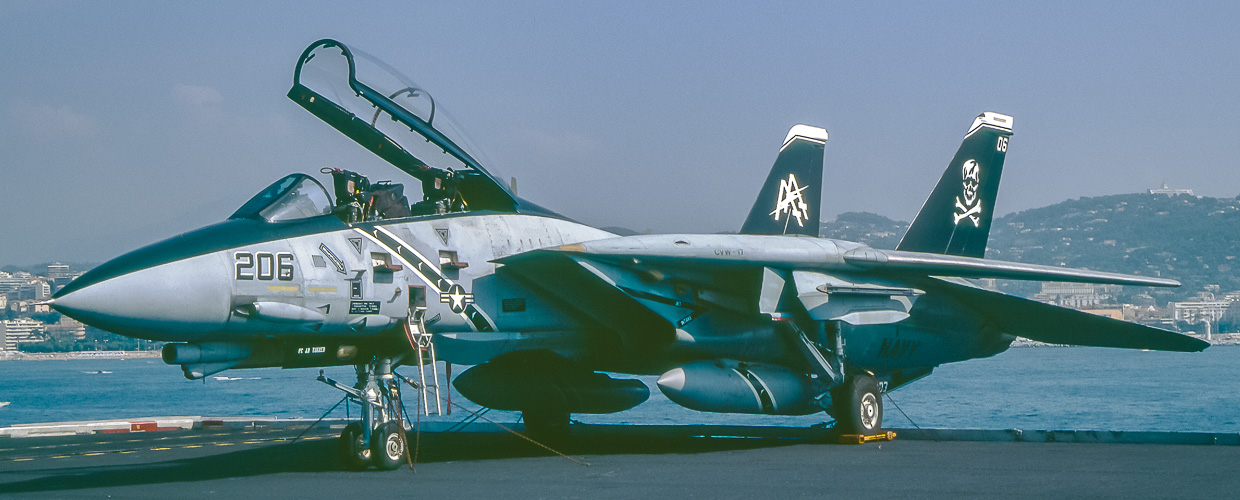
Considered by many as the most beautiful jet fighter, at least of its generation, the F‑14 Tomcat is also famous for the movie 'Top Gun'. Typically for a fighter designed in the early 1970s the F‑14 Tomcat has double vertical stabilisers and rectangular, wedge shaped air intakes at the side of the fuselage. The vertical stabilisers are tilted outwards a bit, while the air intakes are tilted inwards. There is quite some space between the two engines. The F‑14 has high mounted, variable sweep wings. The single wheel main gear retracts in the wings leading edges or the wing gloves. The nose gear has two wheels. Up front is a two seat cockpit with a canopy that opens in one piece.
How to recognise the different versions of the F-14
The different versions of the F-14 Tomcat can be distinguished by looking at:
- the shape of the nozzles (exhausts)
- the presence of extendable vanes in the wing gloves
- the number of sensors under the nose
YF-14A
Like with many military airplanes the prototypes of the Tomcat, designated YF-14A, differed in some ways from the production F-14A. Of course the YF-14A has a long probe attached to the tip of the nose. More importantly, the end of the wing gloves is perpendicular to the fuselage centreline. This is also visible in the length of the outer of the two wing fences on top of the wing gloves: they both extend to the same point. Finally, some YF-14As had a sort of rectangular canards below the front of the canopy, to recover from spins.
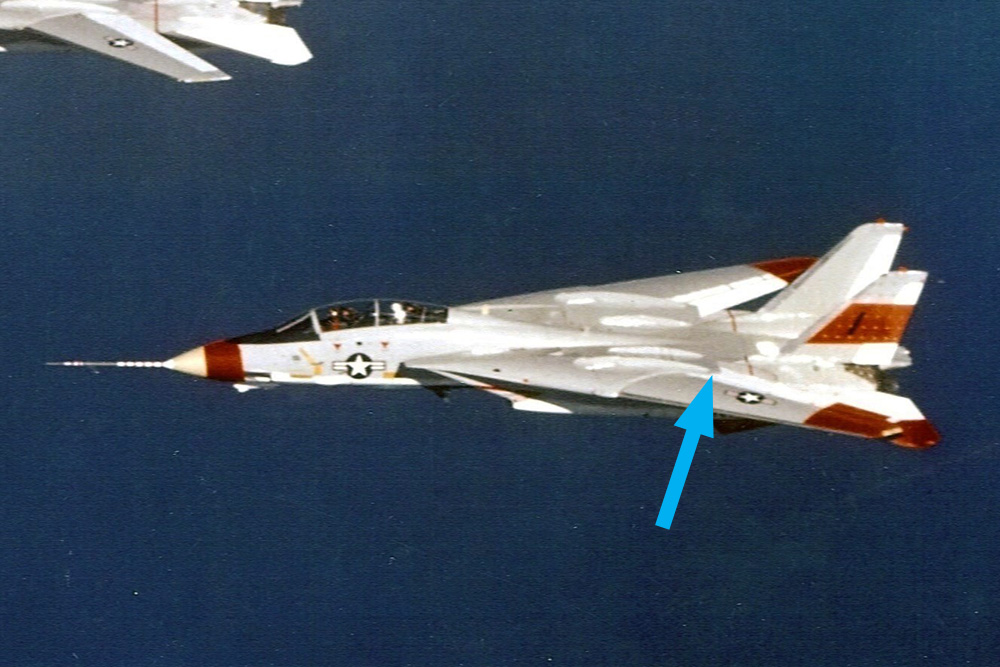
Here is one of the YF-14A prototypes, with a long probe on the nose. The arrow points at the equal end of the wing fences, typical for the YF-14A. (photo: US Navy/Wikimedia)
F-14A
The original version of the Tomcat was powered by Pratt & Whitney TF30 engines. Its exhausts have relatively short nozzles. Another key feature of this version are the triangular vanes that can be extended from the wing gloves, i.e. the leading edge extensions that fit over the pivot points of the wings. Compared to the YF-14A the 'canards' next to the canopy are gone, as it the long probe on the nose. Furthermore, the rear end of the wing gloves is canted, also visible in the outer fences ending before the inner fences.
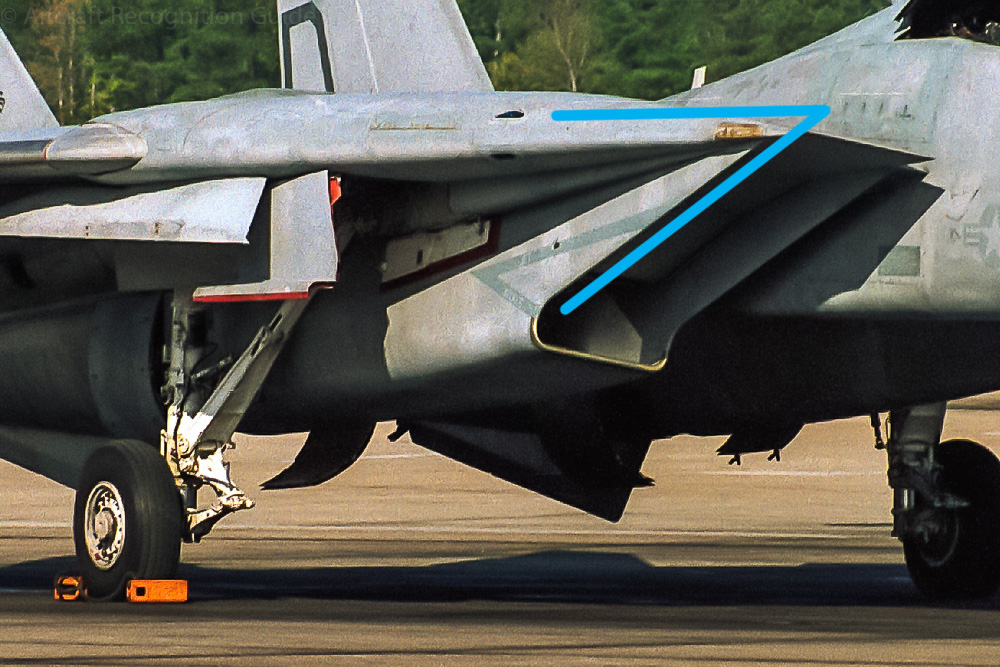
Over the years the F-14A received several minor 'block' updates. The most visible onces include the presence of a nose pitot tube (added from Block 90), the shape of the 'beaver tail' in between the engines (two-step from Bock 75) and the purging vents for the cannon (gun muzzle) on the left side. Originally, the latter had vertical grid openings, later (from Block 125?) this changed to triangular intakes. The antenna configuration and sensors under the nose may also differ.
Iranian Tomcats are externally the same as the US Navy F-14As, expect that the refuelling probe on the right side has no cover.
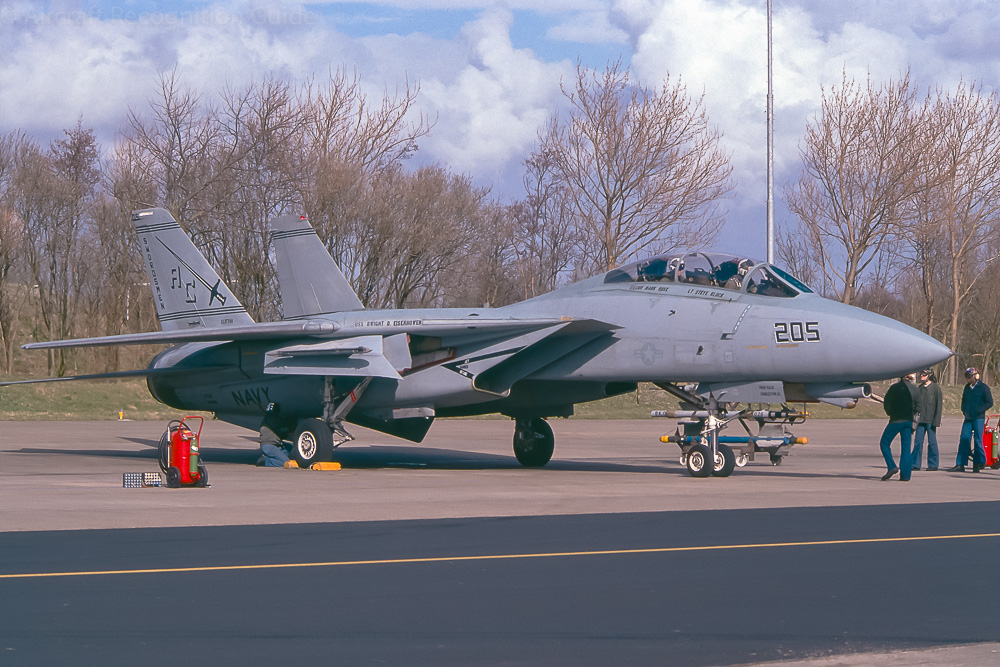
F-14A was the first version of the Tomcat, that only received major upgrades in the late 1980s.
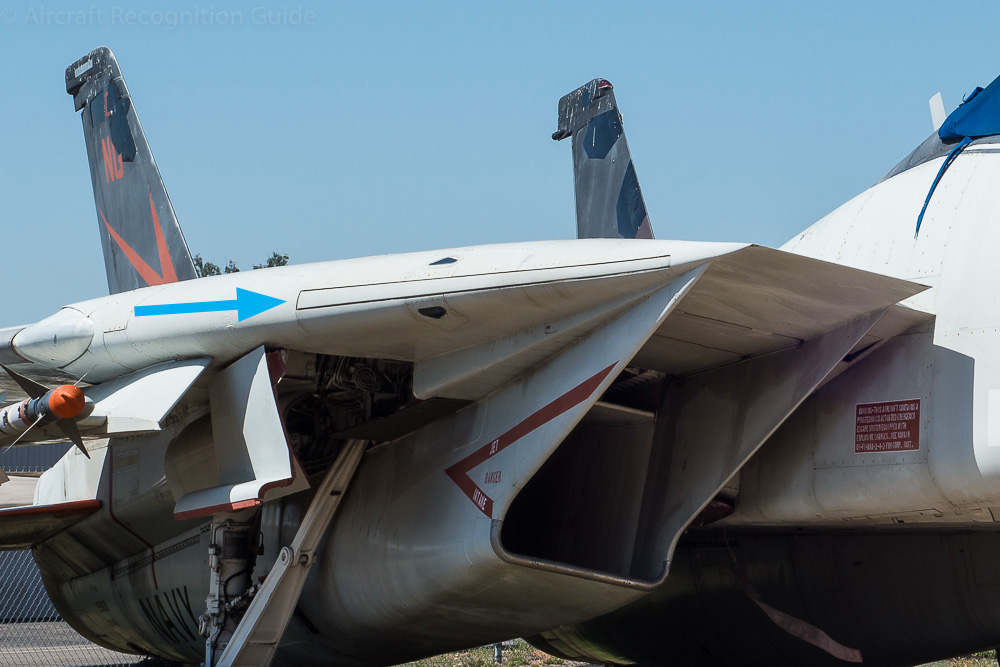
Extendable vanes in the wing gloves are another feature of the A model. Here they are retracted, the standard position.
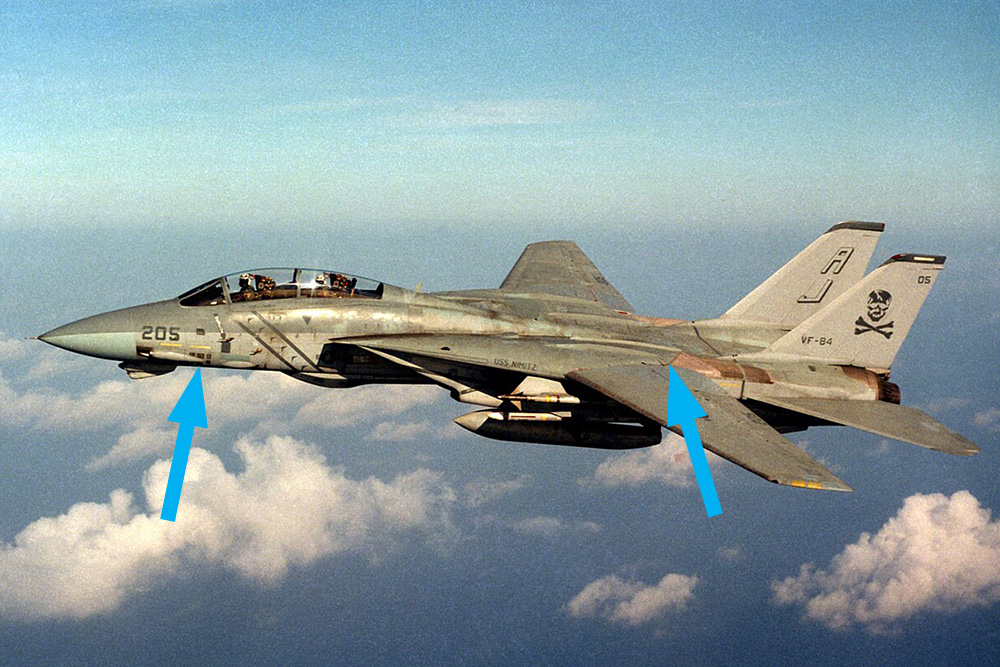
This is an early block model F-14A, judging the grid type gun vents marked by the left arrow. The right arrow points to the shorter outer wing fence compared to the YF-14A. (photo: US Navy/Wikimedia)
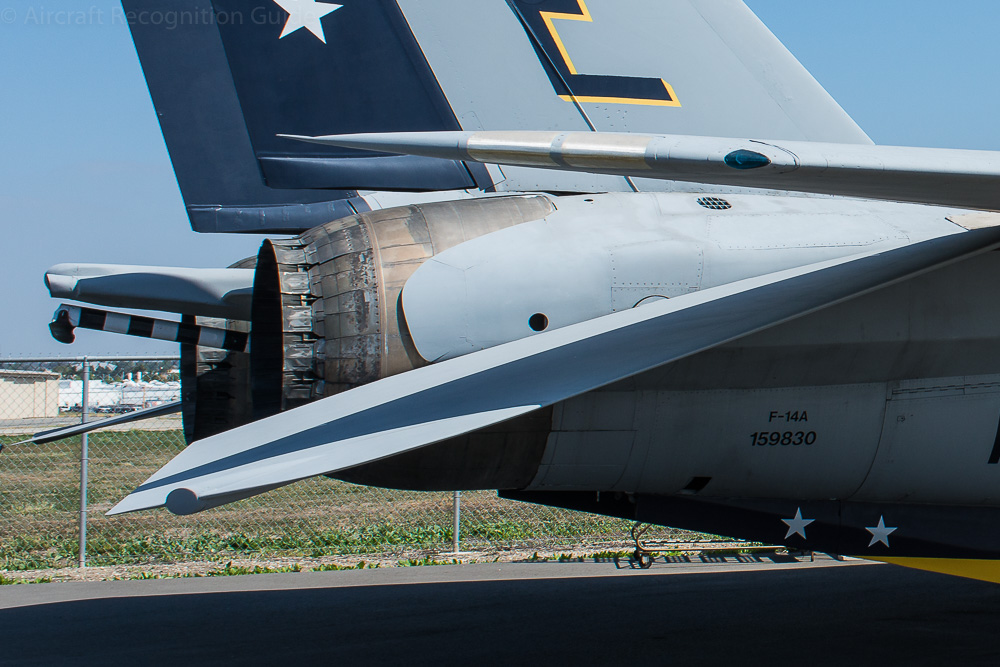
The TF30 engines have exhaust nozzles that like shown here. It is one of the recognition points of the F-14A.
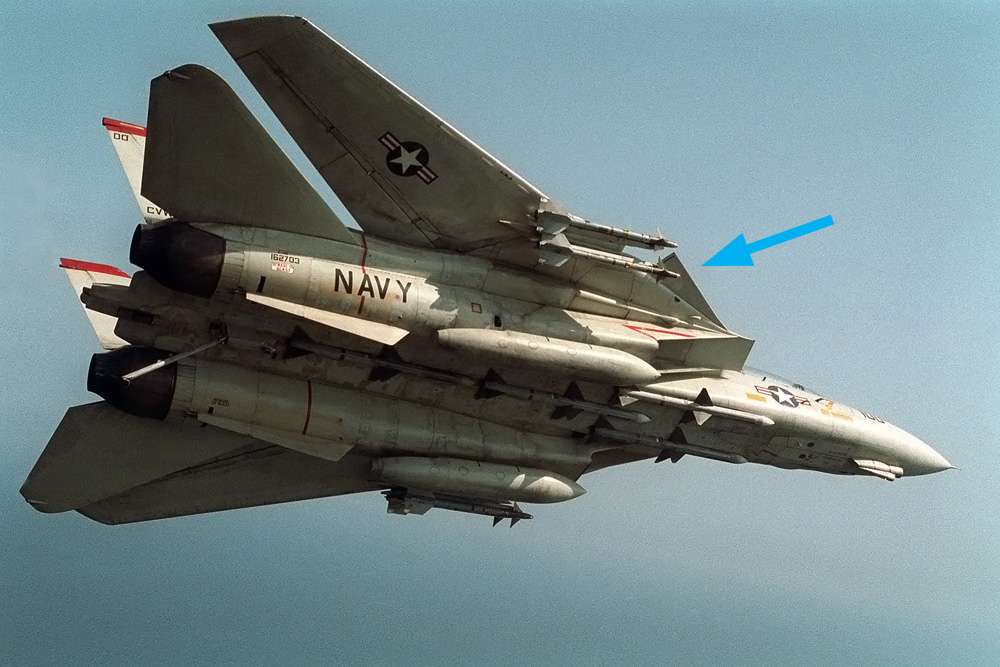
On this photo the triangular vanes in the wing gloves of the F-14A are extended. (photo: US Navy/WikiMedia)
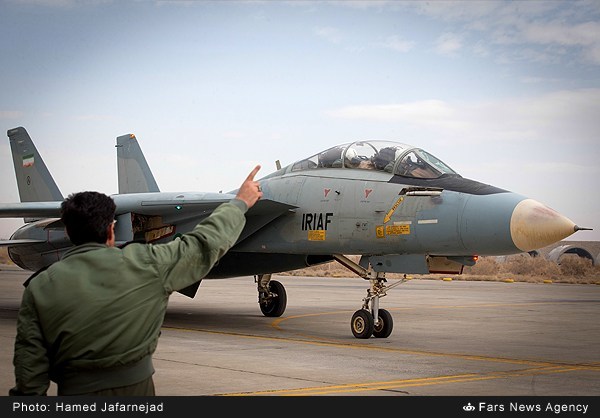
The only other user of the F-14 was the Iranian air force. The F-14A of Iran is externally virtually the same as the USA Navy examples, except for the lack of a cover for the refuelling probe. (photo: Hamed Jafarnejad/Wikimedia)
F-14B
The designation F-14B was used for several upgraded versions of the F-14A, all with General Electric engines, and including the name Super Tomcat. None lead to more than converting one of the YF-14A prototypes. The final configuration was first called F‑14A+, but became F‑14B after all. These General Electric engines have longer exhaust nozzles than the TF30s of the F‑14A, with more clearly visible afterburner petals. Another change is the removal of the wing glove vanes. All F‑14Bs are converted late model F‑14As.
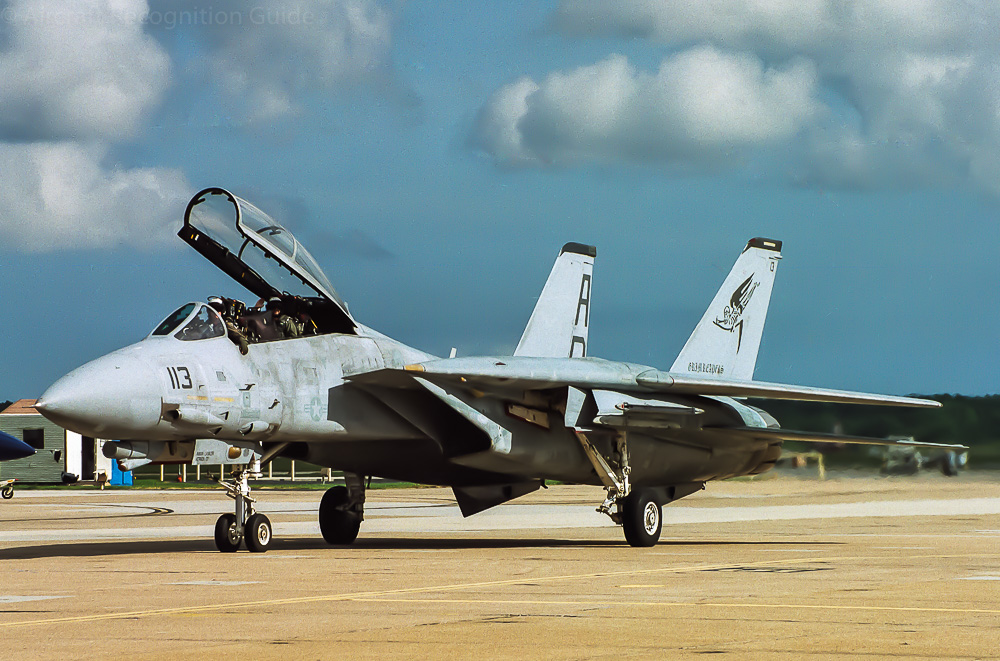
The F-14B was the first upgraded version of the F-14A. Externally the difference is mainly visible in the exhaust nozzles and the absence of the vanes in the wings leading edges.
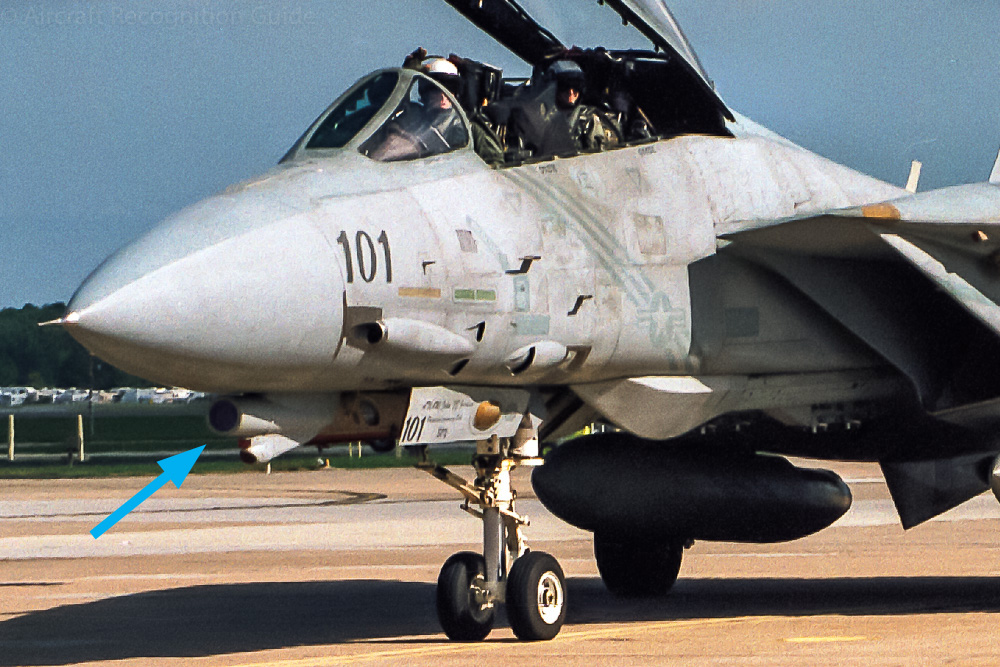
The F-14B has a single sensor pod under its chin, as does the F-14A though. But this is the best way to distinguish the F-14B from the F-14D.
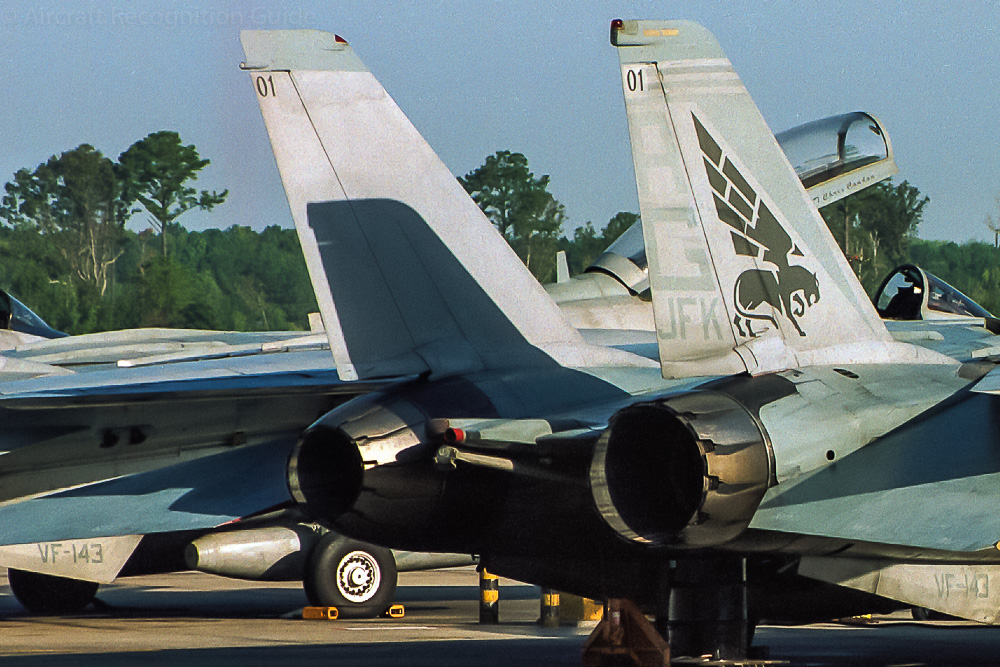
From this angle you can better see the different nozzles of the General Electric F110 engines. They have longer plates forming the variable diameter exhausts.
F-14D & F-14D(R) Super Tomcat
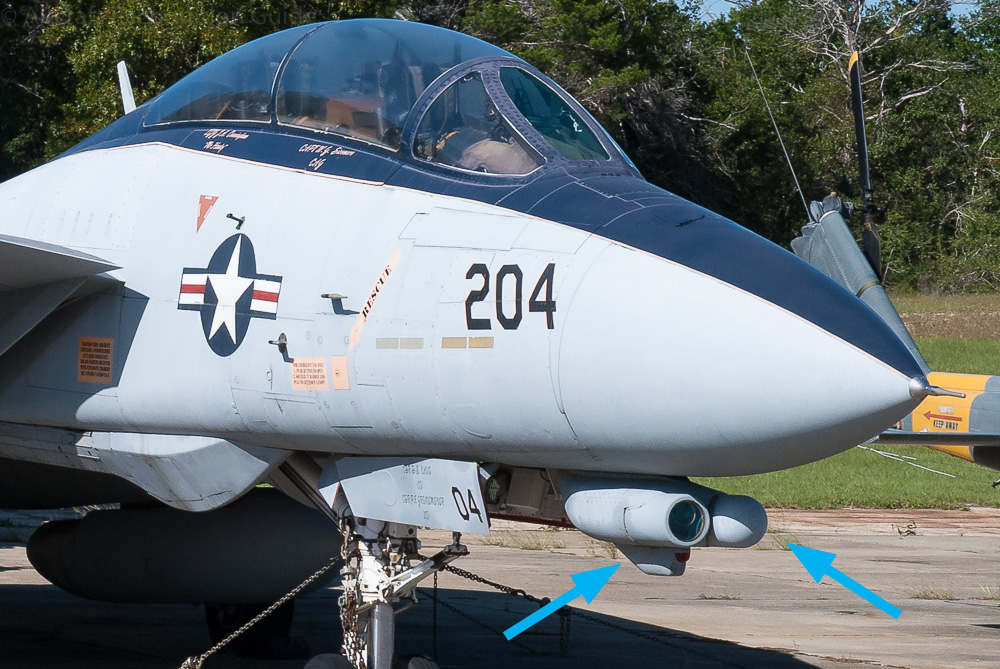
At the same time the F-14B was developed as upgrade to the F-14A, Grumman also made the new F-14D. This Super Tomcat shares most of the updates of the F-14B, including the General Electric F110 engines and removal of the wing glove vanes. Additionally, the F-14D has digital displays in the cockpit and a different radar. Multiple other systems were upgraded as well, resulting in a second sensor pod under the nose, next to the existing one. Additionally, several small sensors were placed in recontoured wing extensions, at the outer top corner of the air intakes.
While F-14Ds are newly built aircraft, F-14D(R)s are converted F-14As (with the R standing for rebuild). Externally, they are virtually the same as F-14Ds.
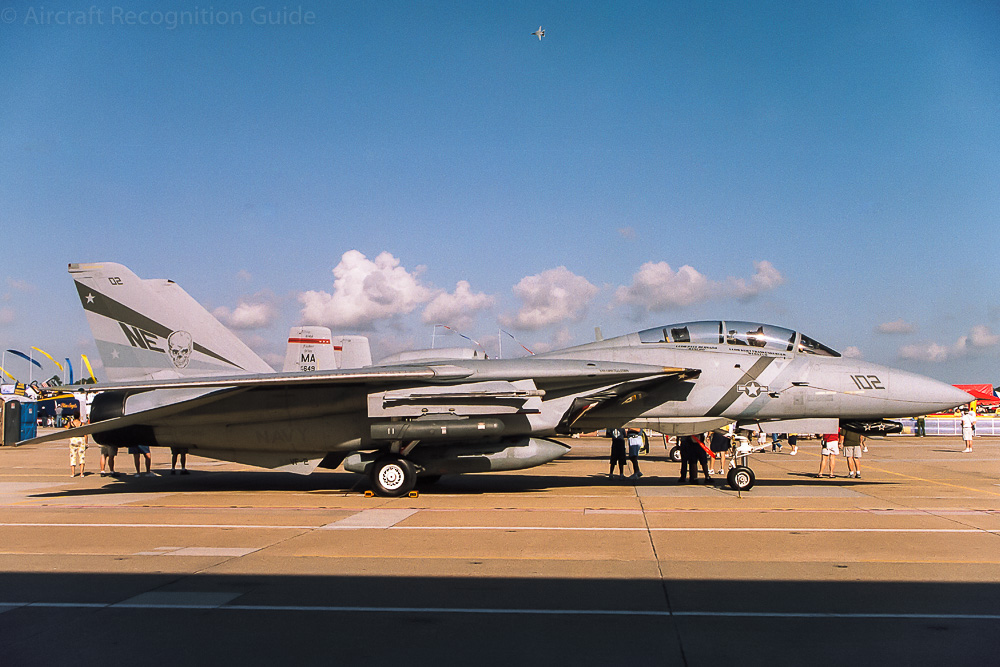
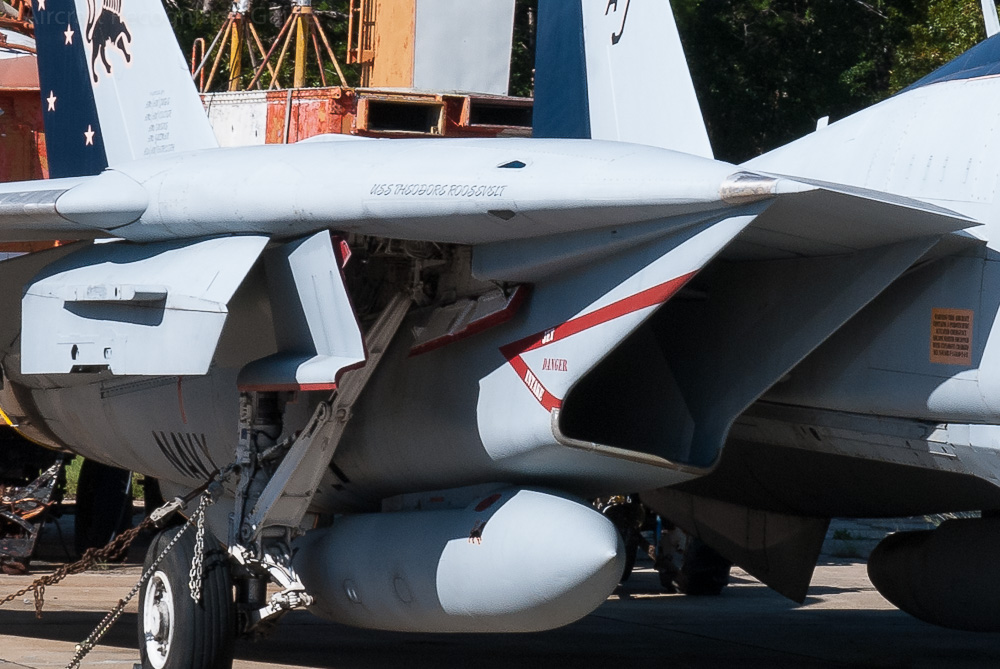
.jpg)
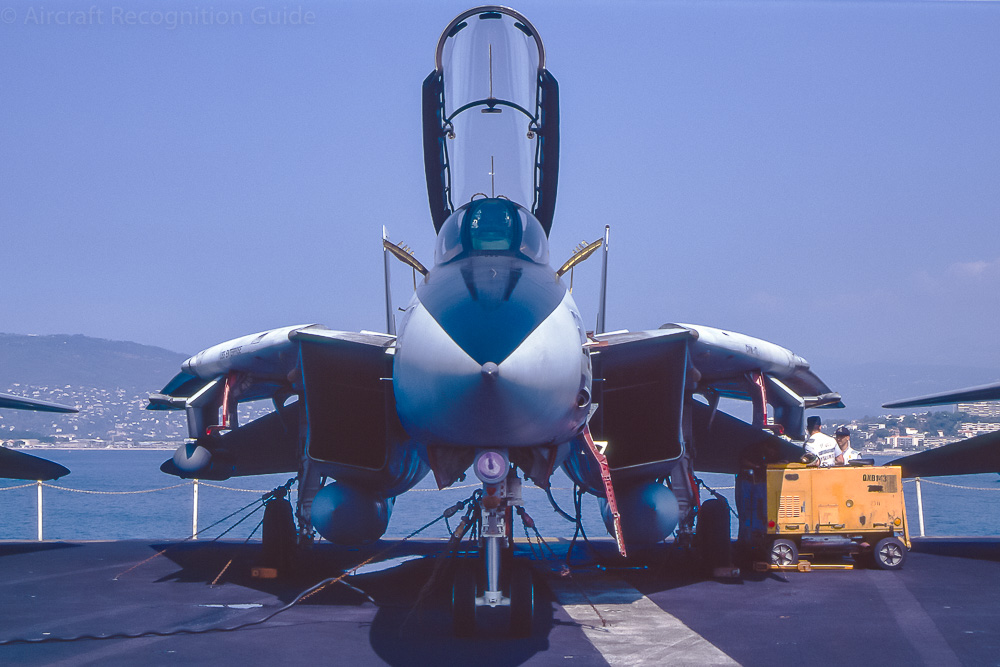
You have to view the F-14D Super Tomcat more from the front to see that it has two sensor pods under its chin.
Similar aircraft
Some airplanes look so similar to the F-14 Tomcat that you may confuse them. Below you can read how to distinguish them.
Differences F-14 Tomcat & F-15 Eagle

Being of the same generation, the F-15 Eagle is one of the fighters that mostly resembles the F-15. The F-15 however has cropped delta wings, straight vertical stabilisers, a single nose wheel and straight air intakes. Finally, the F-14 always has a two seat cockpit while the F-15 can have a one seat.
Differences F-14 Tomcat & MiG-25/31
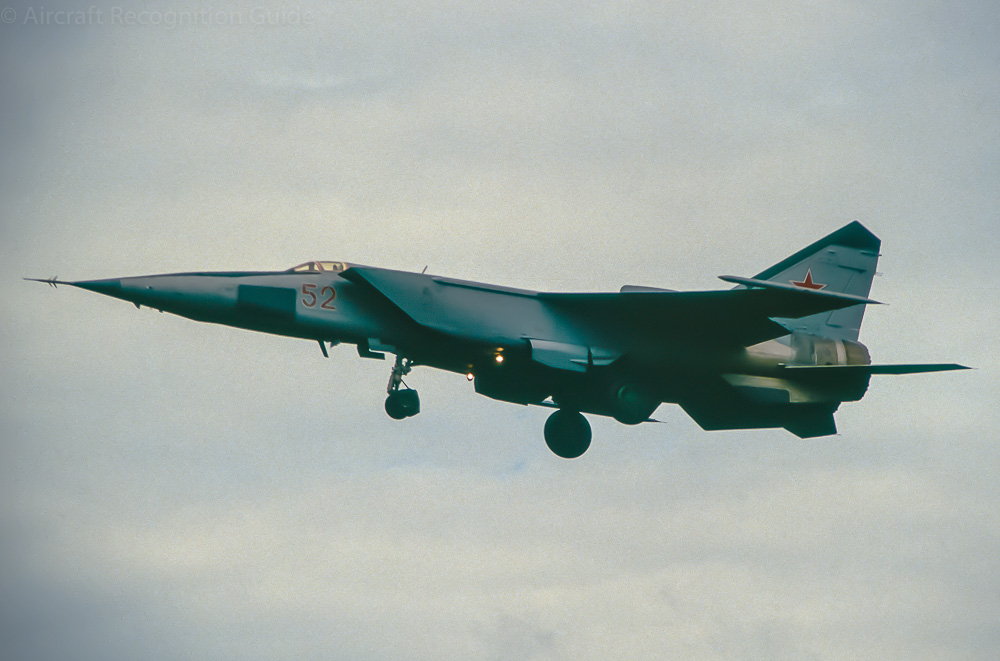
The MiG-25 and MiG-31 are also similarly shaped as the F-14. However they have no (long) bubble canopy, but straight vertical stabilisers, fixed wings and air intakes.
Differences F-14 Tomcat & F-22 Raptor
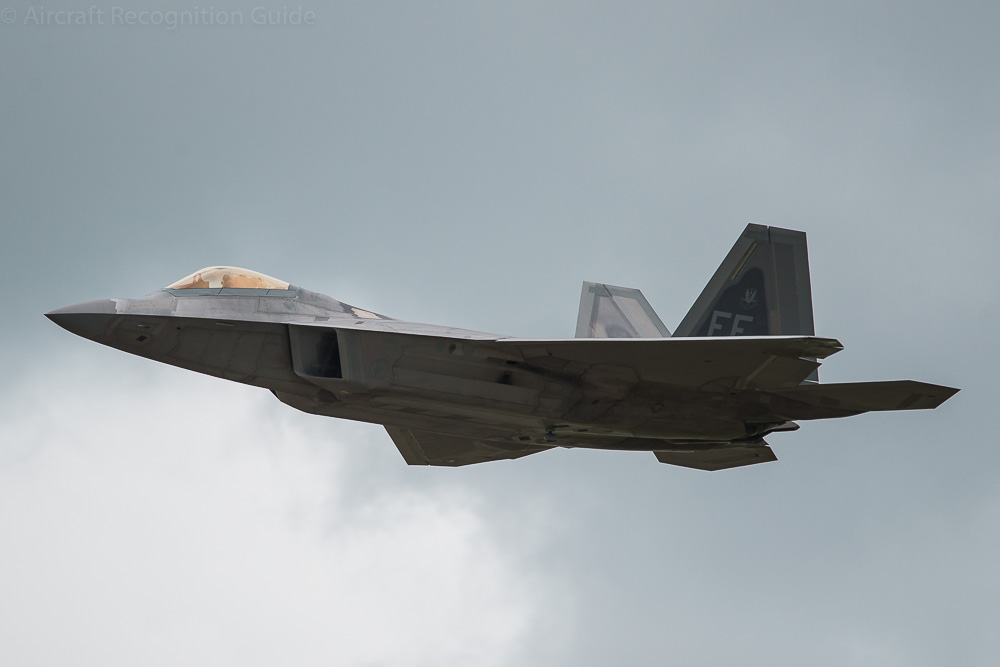
The F-22 Raptor also has two outward tilted fins, a single seat bubble canopy and rectangular air intakes, but of a different shape when viewed from the side. Also it has regular, fixed delta wings.
Differences F-14 Tomcat & MiG-29

The Fulcrum has the same basic characteristics as the F-14, with one big difference: the wedge shaped air intakes are underneath the forward fuselage instead of on the side of the fuselage. And of course the wings are fixed. The same applies to the Sukhoi Su-27 family.