
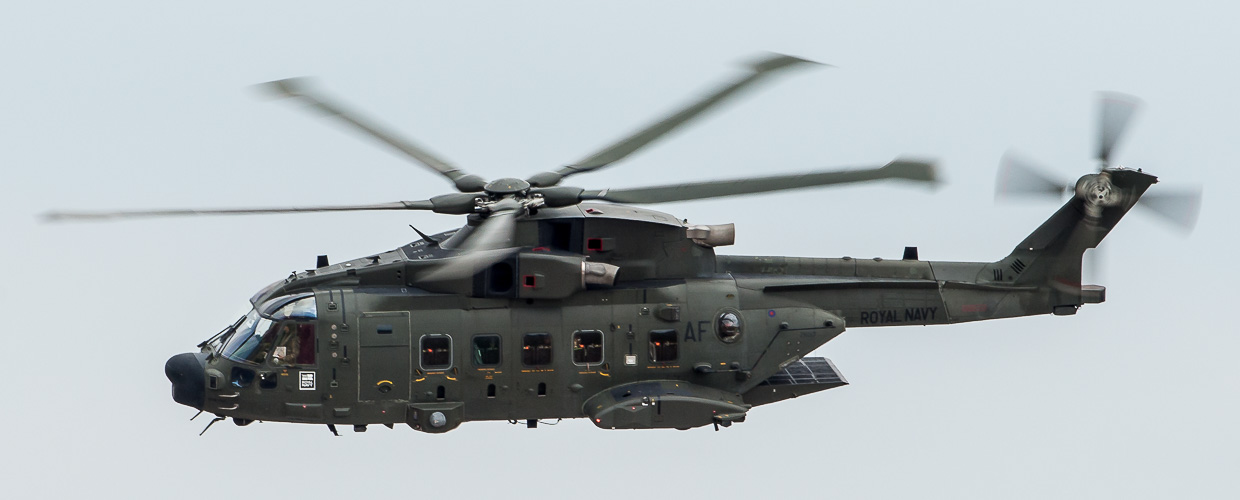
Leonardo AW101 (EHI EH101)
This helicopter started from a need to find a replacement for the Sea King helicopters, both in the United Kingdom and Italy. Hence Westland and Agusta teamed up under the name of EH Industries to develop the EH101. This was marketed as AW101 when the companies merged to AgustaWestland, and this remained when the merged company came under the umbrella of Leonardo.
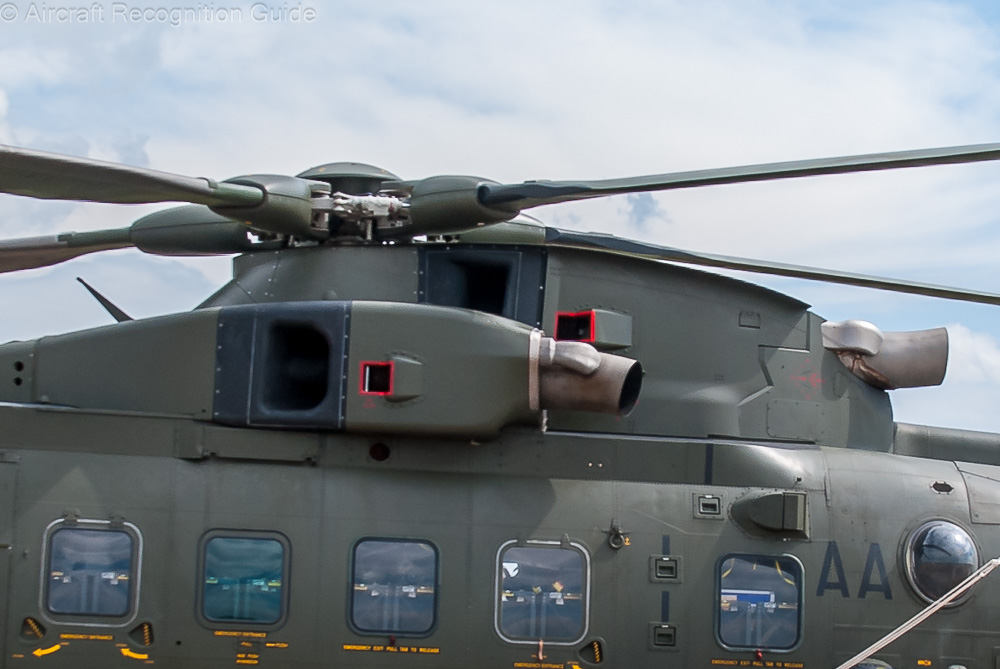
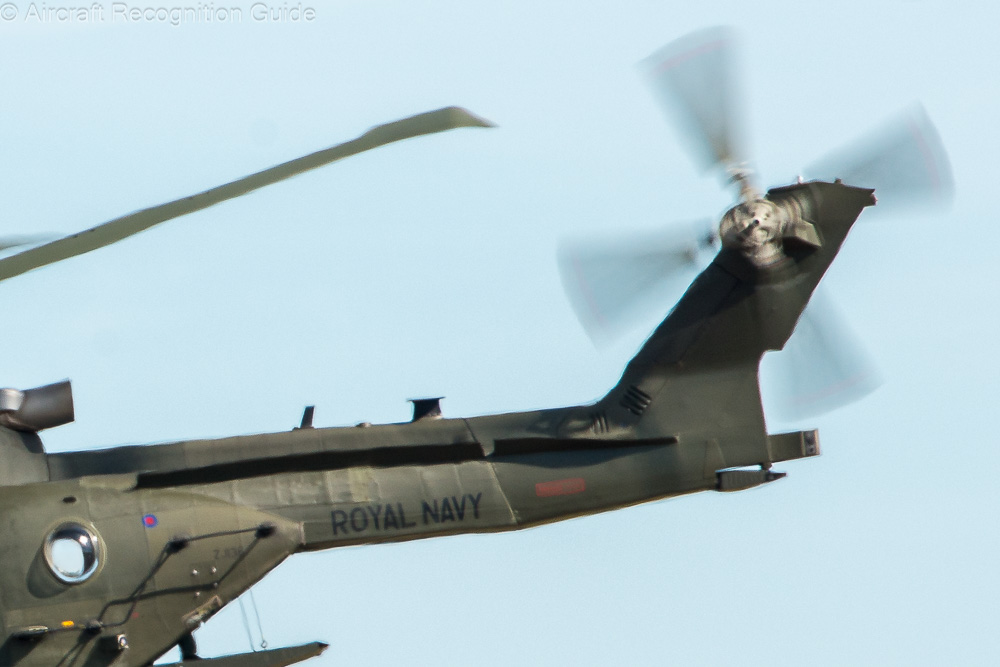
The EH101/AW101 is quite a large helicopter with three engines. One is in the middle, behind the main rotor axis, and fed by an air intake on the left side of the pylon on top of the fuselage. The other two are placed at the sides of this pylon, with separated exhausts pointing a bit outward. The engines power a five blade main rotor with wide, curved blade tips, and a four blade tail rotor that is on the left side at the top of the vertical stabiliser. The helicopter has small sponsons in which the main gear retracts. On most versions all gears have two wheels, but some versions have single wheel main gears. Finally, the rear fuselage differs per variant: some versions have a rear loading ramp while others haven't but have a smoother transition from fuselage to tail boom. Along the majority of the tail boom is a long strake.
Over the years the EHE01/AW101 has had a few design tweaks, but this is not reflected in model designations or marketing names. The original production models used the BERP 3 main rotor blades. As the years went they were replaced by the BERP 4 blades. These blades have anhedral on the tips, but still retain the classic shovel shape. Initially, the Merlins also had a tail rotor comprised of two stacked yokes with two blades on each yoke. After an accident they were all replaced with a fully articulated hingeless tail rotor still with four blades.
How to recognise the different versions of the AW101 (EH101)
The different versions of the EH101/AW101 can externally be distinguish by
- the shape of the rear fuselage, with a rear loading ramp or not
- whether the tail boom can be folded
- whether the main rotor blades can be folded
- the number of wheels on the main landing gear
- the pattern of the cabin windows
- the presence and shape of bulges and antennas under and on the nose, and underneath/at the side of the fuselage
- the presence of a refueling probe
- the number of hoists
- the presence of a fast rope beam
- the presence of radar warning receivers at the sides of the nose
- the presence of a large radar dome at the left side of the fuselage
- the presence of a cargo hook that can be stored inside or outside the underside of the fuselage
- the presence of rectangular access panels above the cabin door
- the presence of rear view mirrors at the sides of the nose or next to the cockpit side windows
The main versions of the EH101/AW101 are:
- Mk100 series, the basic naval and anti-submarine version. It has no rear loading ramp and the rear fuselage gradually slopes up to the tail boom, reaching it where the vertical stabiliser starts. There is a large, disk-shaped radar under the front fuselage. Moreover, the Mk100 has a folding tail and folding main rotor blades as standard. Four of the main rotor blades have cutouts on the blade cuffs to facilitate folding.
- Mk300 series, mainly for the civil market. It is characterised by many cabin windows, no radar under the nose and has no rear loading ramp.
- Mk400 series, the basic military transport variant. This differs from the Mk100 and Mk300 variants essentially by having a rear loading ramp. This is visible in the more sharply tapering rear fuselage.
- Mk500 & Mk600 series, these seem to be upgrades of the Mk400 series.
- Mk640 series: the VIP variant.
EH101 pre-production versions
Nine pre-production EH101s were built, six navy versions without a rear loading ramp (EH101 Mk100, PP1 to PP6), one civil (EH101 Mk300 , PP8, see description below) and two with a rear loading ramp (EH101 Mk400, PP7 & PP9). These pre-production helicopters initially had horizontal stabilisers on both sides, but to solve stability issues it moved to the right side only. Also, the gear box hub and exhausts were shorter, and the shape changed a bit (difficult to describe). Finally, the main rotor root ends were not aerodynamically covered.
PP1, PP2 and PP3 were basic airframes without mission equipment like the search radar. They could have a long tube in front of the nose with test instruments. PP4, PP5 and PP6 had the radar disk fitted (or at least the housing for it), and a part of the mission systems. All six had single wheel main gears, two large cabin windows on the left and three on the right. PP7 and PP9 also had single wheels, but five cabin windows on each side.

EH101 Mk110 (SH-101A)
The basic Italian navy anti-submarine warfare version is called SH-101A. It is based on the Mk100 series with a small disk-shaped radar under the nose. Additionally, there is a round sensor turret under the nose, on the right side. Across on the left side is a tube with a barrel shaped sensor at the end. There are two large cabin windows on each side, on left side in the middle and above the sponson, and on the right side near the cockpit and above the sponson. Aft of this window against the side of the fuselage are from top to bottom a protruding exhaust, a long oval sensor and a black ice hockey puck antenna. On the left side this black puck is missing.
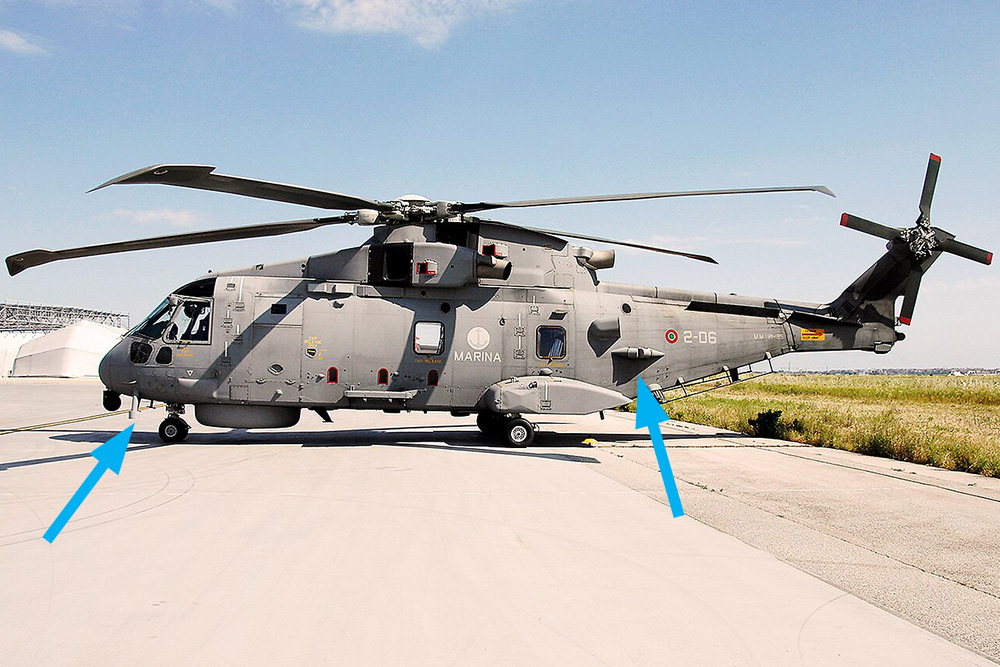
The SH-101A is the basic anti-submarine EH101 of the Italian navy. You can distinguish it from the British Merlins by the vertical tube under the nose and the two 'pimples' against the rear fuselage, both marked by the blue arrows. (photo: Aldo Bidini/Wikimedia, modified)

All EH101 Mk100 series have foldable tail booms, recognised by the hinge on the rights side.
EH101 Mk111 (Merlin HM1)
The first navy version of the British has as basis the Mk100 frame, so without the rear loading ramp but with the disk-shaped radar. Typically, the Merlin HM1 has single wheel main landing gears. The version also has a small round sensor turret on the right side, just in front of the side door, although some examples haven’t. Moreover, the HM1 can carry torpedos under flat panels attached to the lower side of the fuselage, in front of the sponsons. There are large cabin windows on both sides, behind the cockpit and above the sponson, with a third one in the middle on the left side. The black ice hockey puck antenna like that of the SH-101A is on the right side only, and there are no other protrusions there. The nose is rather clean, except for radar warning receivers at the sides, in front of the lower cockpit windows. There are rear view mirrors next to the cockpitside windows.
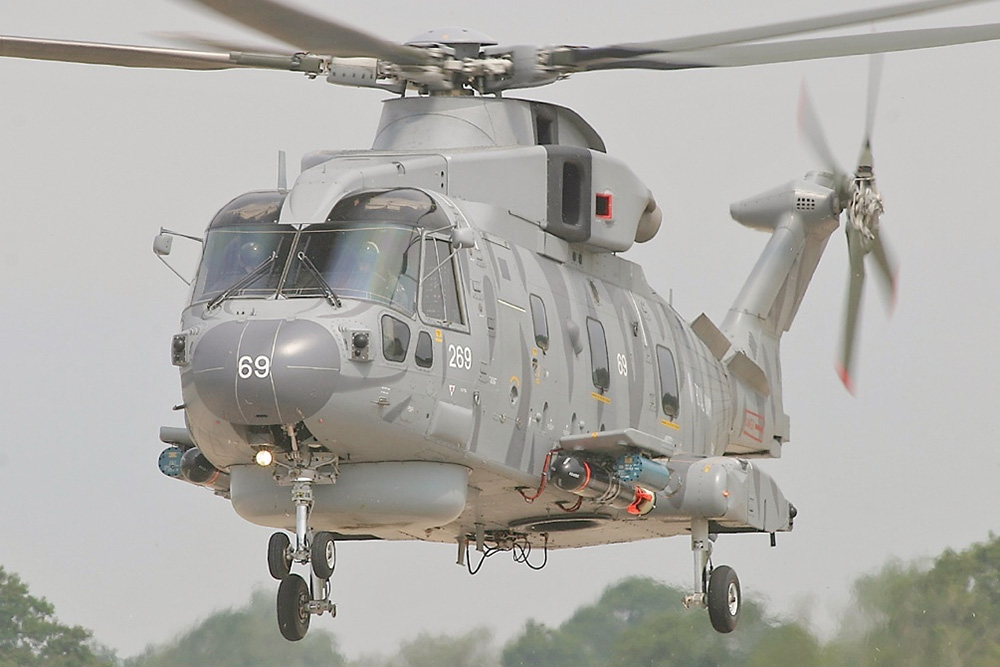
Here is a front left view of the Merlin HM1, showing the rectangular flat plates, that can be used to store torpedos, and the single wheel main gears that are only found on a few EH101 versions. (photo: Mike Freer - Touchdown-aviation/Wikimedia)
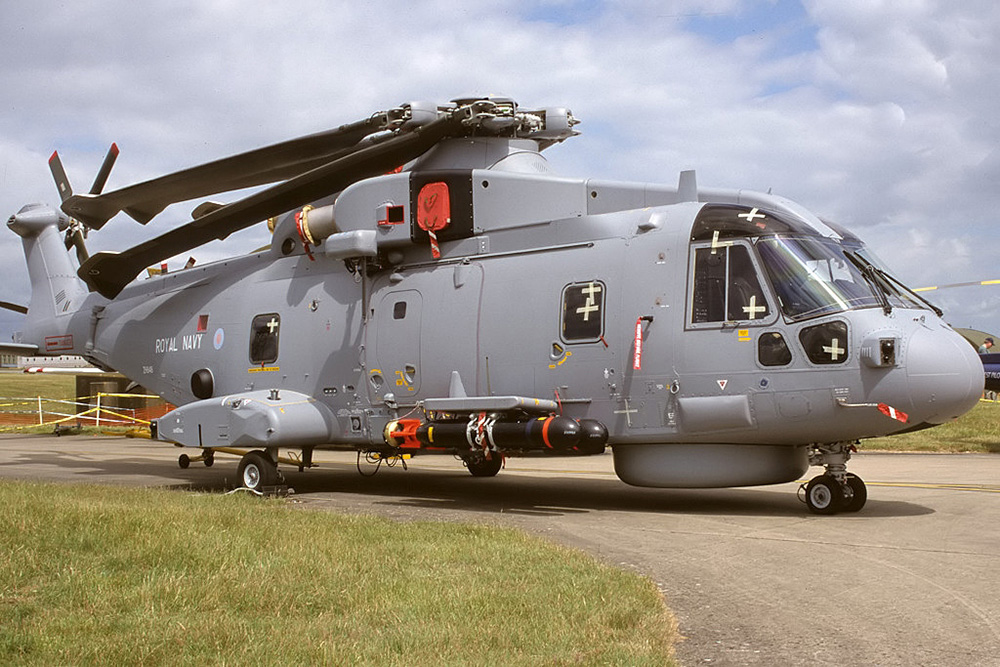
On the right side of the Merlin HM1 are only two large cabin windows, at the extreme end of the cabin. Here the main rotor blades are folded. (photo: Mike Freer - Touchdown-aviation/Wikimedia)
EH101 Mk111 (Merlin HM2)
A major system upgrade of the Merlin HM1 resulted in the Merlin HM2. Externally, the main difference is the addition of two swept blade antennas under the nose. The HM Mk 2 also has the ability to carry a large dome-shaped airborne early warning (AEW) pod at the left rear side of the fuselage, similar to that of the Sea King ASaC7. It is also known as the ‘Crowsnest’.
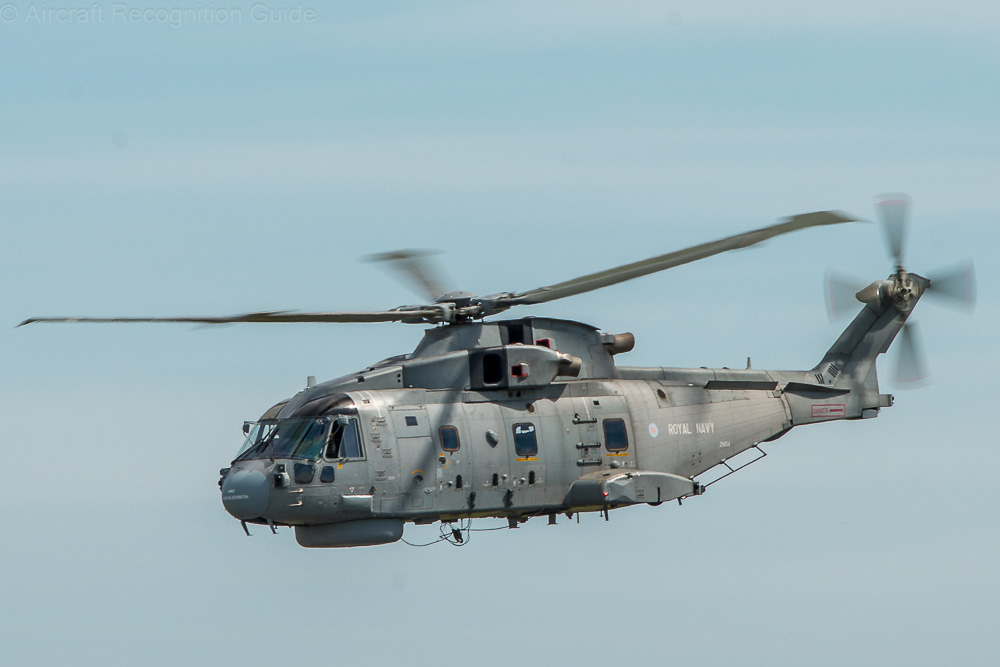
A Merlin HM2 in full flight, recognised only by the two swept blade antennas under the nose, in absence of the 'Crowsnest' radar.

The large AEW radar that can be fitted on the Merlin HM2 can hardlt be missed! (photo: UK Ministry of Defence/Wikimedia, modified)
EH101 Mk112 (EH-101A)
This is the Airborne Early Warning (AEW) version of the Italian navy. It is externally the same as Mk110 (SH-101A), but with a large diameter radar that is wider than the fuselage.

The Italians chose a different concept for the airborne early warning radar than the British. On the EH-101A it is a disk shaped radar under the forward fuselage, with a larger diameter than the anti-submarine radar. It is wider that the fuselage width.
EH101 Mk300 Heliliner
The civil Heliliner version was meant in particular for the offshore industry. In the end it found no customers and only a prototype was built. It is characterised by five large cabin windows on each side, no rear loading ramp and single wheel main landing gears.

Just one EH101 Mk300 was built, and that is now in a museum. It has a clean nose, five cabin windows and single wheel main landing gears.
EH101 Mk410 (UH-101A)
The UH-101A is the first Mk400 series version, so it has a rear loading ramp. This is visible in the more quickly tapering rear fuselage. For the rest this Italian navy transport variant is very similar to the MH‑101A below. It only has a sensor turret under the normal nose, without the additional fairing on top of it. Sometimes, the sensor itself is not present, but the mount always is.

The first Mk400 series EH101 was the utility version for the Italian navy. This UH-101A has a pretty clean nose: only the mount for the optional sensor turret is visible. (photo: Aldo Bidini/Wikimedia)
EH101 Mk411 (Merlin HC3)
This was the first Royal Air Force version, which was later transferred to the Navy. On the left side there are four large nearly square cabin windows, two paired in the middle and two at the ends of the cabin. There are two covered refuelling points, one below the second window and one in front of that. On the right side the are also four large windows, but now the two paired are at the front and one is in the sliding cabin door. There are bubble windows on both sides, near the start of the tail boom. Also on the right is a hoist above the rear end of the cabin door that can be stored against the side of the fuselage when not in use.
In front of the nose are four rod antennas, short ones in the middle and long ones on the sides, and below the nose is a sensor dome on some examples. At the sides of the nose are radar warning receivers. The Merlin HC Mk3 has a cargo hook underneath the fuselage, with a rectangular hole where the hook is stored when not in use.


EH101 Mk411 (Merlin HC3i)
In anticipation of the full HC4 upgrade, a part of the Merlin HC Mk 3 helicopters was already fitted with folding main rotor blades, but no folding tail boom. Additionally, they got a new swingable beam for fast roping and abseiling next to the winch, deck lashing points and a modified gear. These received designation Merlin HC Mk3i (or HC iMk3?), with i standing for interim.

A crew member of this Merlin HC3i is putting the new fast roping beam to use, with the normal hoist being stowed. The nose is still that of the standard Merlin HC3. (photo: Sam Wise/Wikimedia, modified)
EH101 Mk411 (Merlin HC4)
To enable the transfer of RAF Merlin HC3s to the Royal Navy they were upgraded to HC4 standard, including the HC3i. They now all have a folding tail and main rotor blades, a fast roping beam above the cabin door on the right, the cockpit of the HM2, deck lashing mounting points and other improvements. Like the HC3 & HC3i the Merlin HC4 has a cargo hook. The nose is much cleaner, with no sensor dome and no whip antennas, although some have a small fairing underneath the nose and some retain the sensor dome. Finally, the variant has narrow access panels between the side air intakes and the top of the cabin doors.
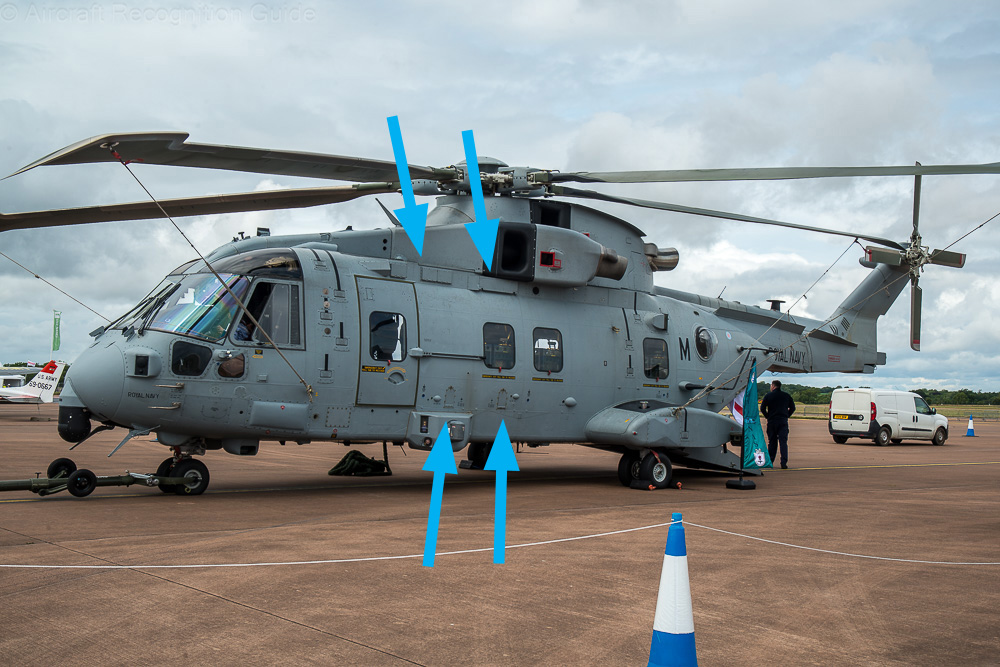
On the left side the Merlin HC4 is recognised best by the access panels marked by the two top arrows. The bottom arrows point at the covered refuelling points, the main difference compared to the Merlin HC4A.
EH101 Mk413 (MH-101A)
This is the Italian navy special forces and amphibious assault transport helicopter, based on the Mk400 series so with a rear loading ramp. It also has folding main rotor blades and tail boom. There are five large cabin windows on the left side and four on the right side (the middle is missing). Additionally, the MH-101A has bubble windows on both sides, behind the last cabin window. The sensors on the nose a turret under the right side of the nose, and a fairing over the normal nose, sometimes with RWRs at the sides.
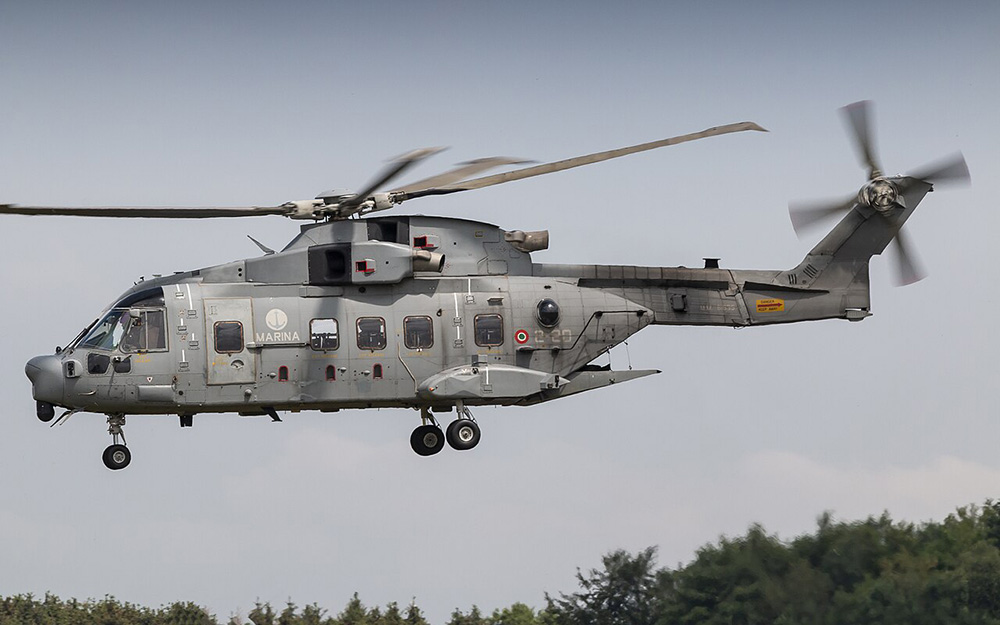
The MH-101A special forces version of the EH101 has a nose job, but not as big as the Danish EH101 Mk512. Otherwise look for the five cabin windows in a 1+3+1 configuration. (photo: Nicky Boogaard/Wikimedia)
EH101 Mk510
Initially, the Mk500 series was used as designation for a civil transport variant with a rear loading ramp. The EH101 Mk510 has five large cabin windows on the left, of which the second one is a bubble version, and six on the right side, with the last but one being a bubble one. Also, it has single wheel main landing gears.
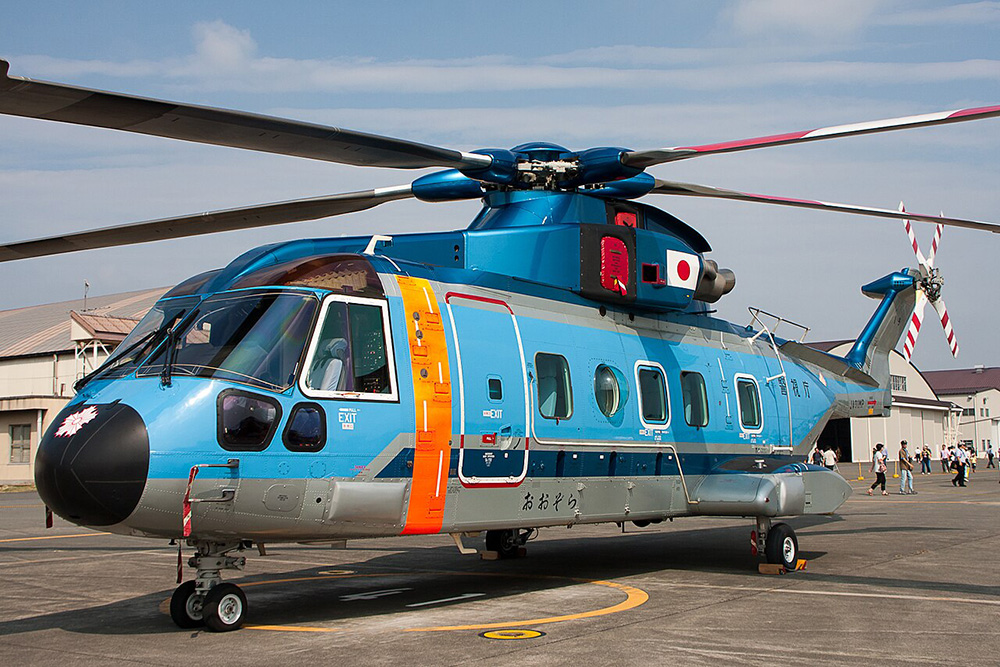
The sole version of the EH101/AW101 with a rear loading ramp and single wheel main gears is the AW101 Mk510. It is a civil version, operated by the Tokyo police. (photo: Ken H/Wikimedia)
EH101 Mk511 (CH-149 Cormorant)
The Canadian search and rescue EH101 is locally called CH-149 Cormorant). It features seven cabin windows on the left, of which the first and last are bubble windows. The windows on the right are nearly the same, but has one square window less, leaving a 1+2+1 configuration. Of course it has a fixed hoist on the right, double wheels, but no specific sensors.
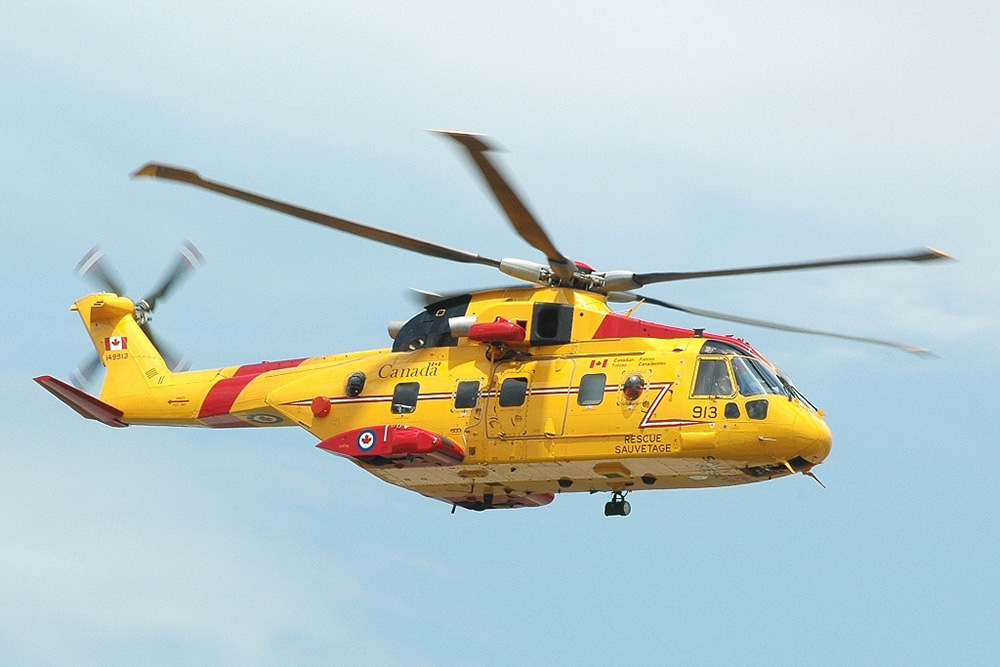
Although being a search and rescue helicopter the CH-149 has a rather clean fuselage, except for the hoist and search light. (photo: Atlantic Aviation Media/Wikimedia)
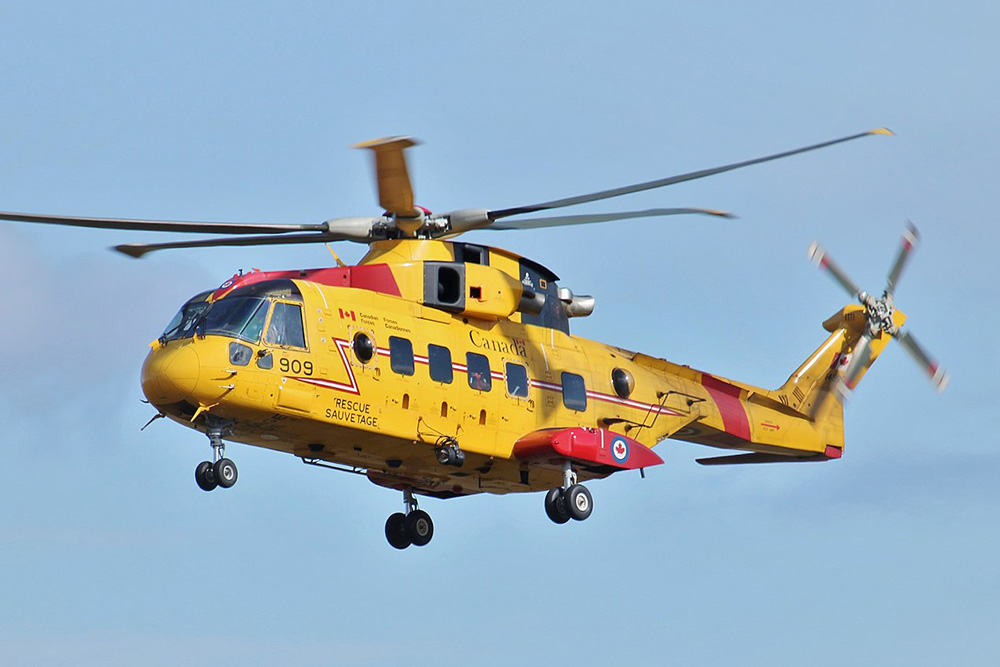
On the left side the CH-149 Cormorant has no less than seven cabin windows, including two bubble windows. (photo: John Davies - CYOW Airport Watch/Wikimedia, modified)
EH101 Mk512
Denmark’s EH101 Mk512 helicopters have a distinctive nose shape thanks to the weather radar on top of the nose, and an optical sensor below. Underneath the nose in many cases a round sensor turret is placed. The version has five equally spaced on the left and five on the right in two pairs and a single, and bubble windows at the end. There are three external refuelling points below the first three cabin windows on the left, which have the shape of a ‘church window’. Finally, the version has double wheel main gears.
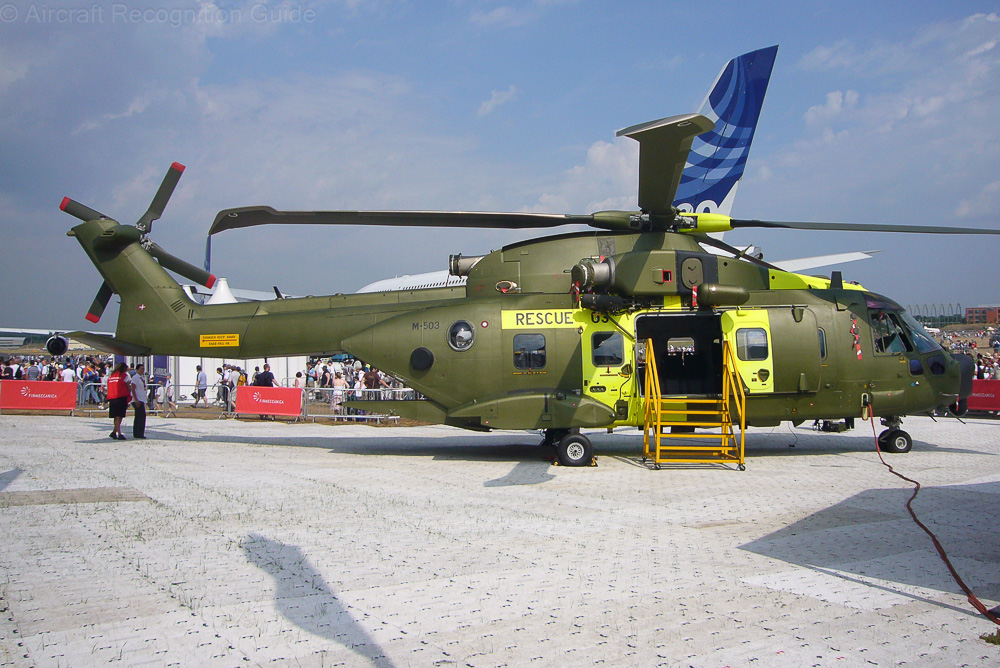
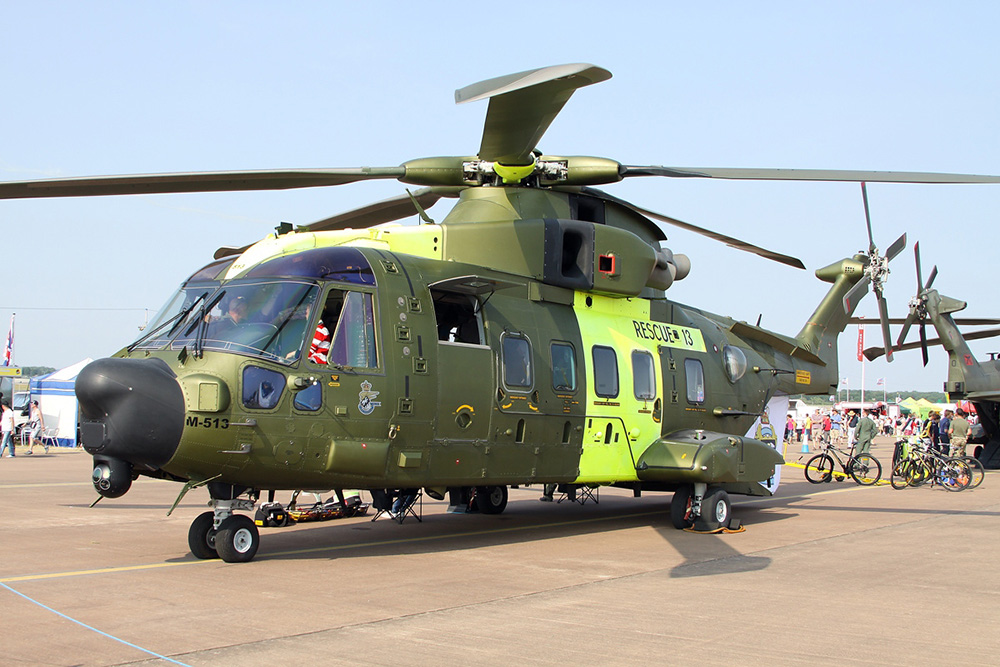
EH101 Mk512 (Merlin HC3A)
Six EH101 Mk512s were obtained from Denmark and these were designated Merlin HC3A after conversion to RAF standards. They retain the distinctive weather radar on top of the nose, with an optical sensor below. Also, the cabin window configuration remains the same, five equally spaced on the left and five on the right in two pairs and a single. The same applies to the three external refuelling points below the middle cabin windows on the left, which have the shape of a ‘church window’. The HC3As also have bubble windows. The fixed winch is above the front part of the cabin door on the right. These helicopters have no cargo hook.


EH101 Mk512 (Merlin HC4A)
The Royal Navy also uses Merlin HC4As which are the HC3As upgraded with most of the HC3 to HC4 mods and more. The HC4 and HC4A are made equal as much as possible. This means amongst others that the Merlin HC Mk4A has the same window configuration as the HC4, so with less windows than the HC3A. Also, the HC4A has no radar nose anymore. Furthermore, the Merlin HC4A doesn’t have a hole to store the cargo hook in the fuselage, but this could difficult to see. The HC4A however has an external hook, held in place by four wires. Finally, the HC4A retains the three non-covered external refueling points.
EH101 Mk514, EH101 Mk515 & EH101 Mk516
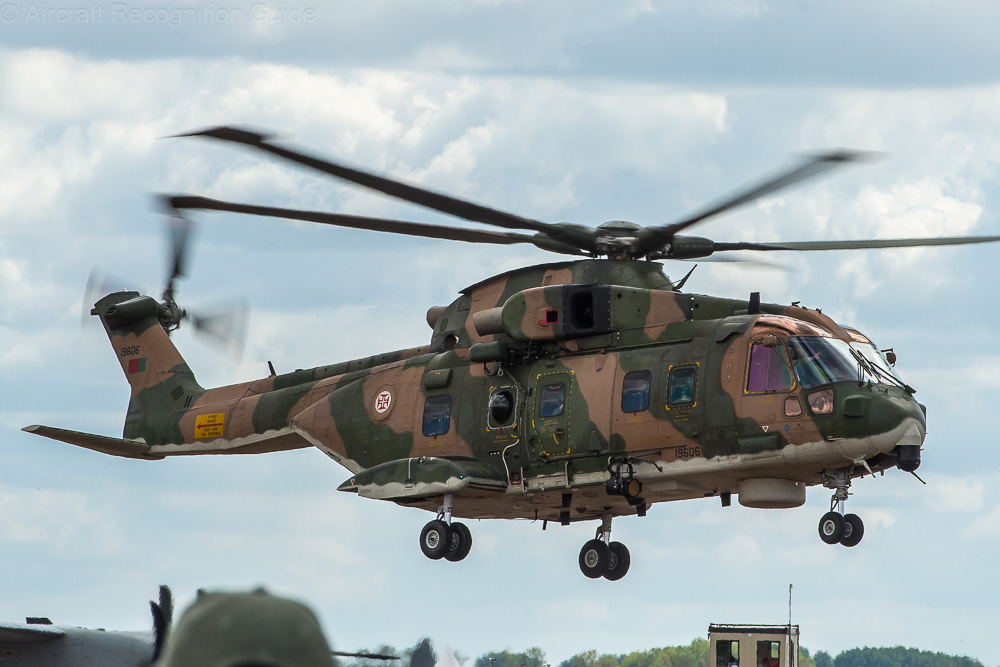
The Portuguese (combat) SAR and fisheries patrol versions have a small disk shaped radar under the front fuselage. There are five large square windows on the left side, preceded by a bubble window. On the right are two square windows near the cockpit, then some space, followed by a square, bubble and square window. There is a winch above the middle of five windows, that can be swiveled to above the bubble window. Under the nose is a round sensor turret.
The Mk514 and Mk515 mutually differ by the small satcom antenna on top of the cockpit ceiling, to provide connectivity for the Mk515s mission computer in the back of the cabin. The Mk515 also has an external loudspeaker.
The EH101 Mk516 is a combat search and rescue variant, that has radar warning receivers at the sides of the nose and at the back of the tail boom. The Mk514 has the bumps for the RWR on the nose, but these are covered. However, more importantly, the Mk516 has a folding tail boom.
EH101 Mk518 (Kawasaki MCH-101)
The Japanese navy uses the EH101 Mk500 series in the mine sweeping role. They are best distinguished by the fixed long pole under both sides of the nose, holding a mirror. It can be equipped with a long refueling probe, pointing slightly up, above the right mirror. Otherwise the nose is rather clean. The MCH-101 has a folding tail boom and main rotor blades, five cabin windows on the left (with the middle one being a bubble type), and five on the right as well. Here the fourth window is the bubble window.
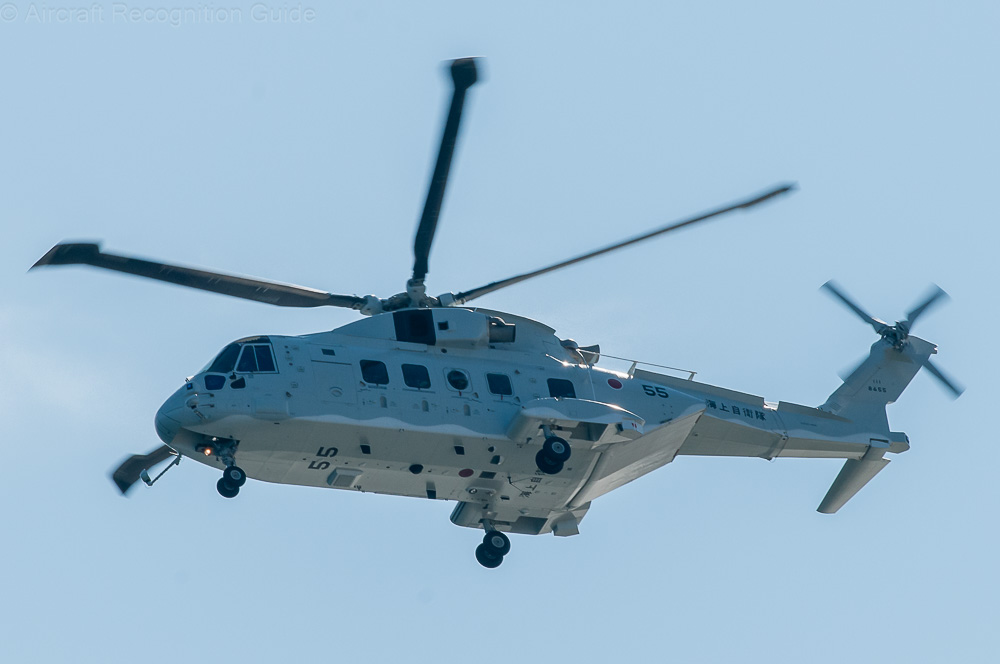
MCH-101 is the local designation of the Japanese navy AW101. It lacks many bumps other navy versions have, but there are two mirrors extending from the nose, to monitor the mine sweeping activities.
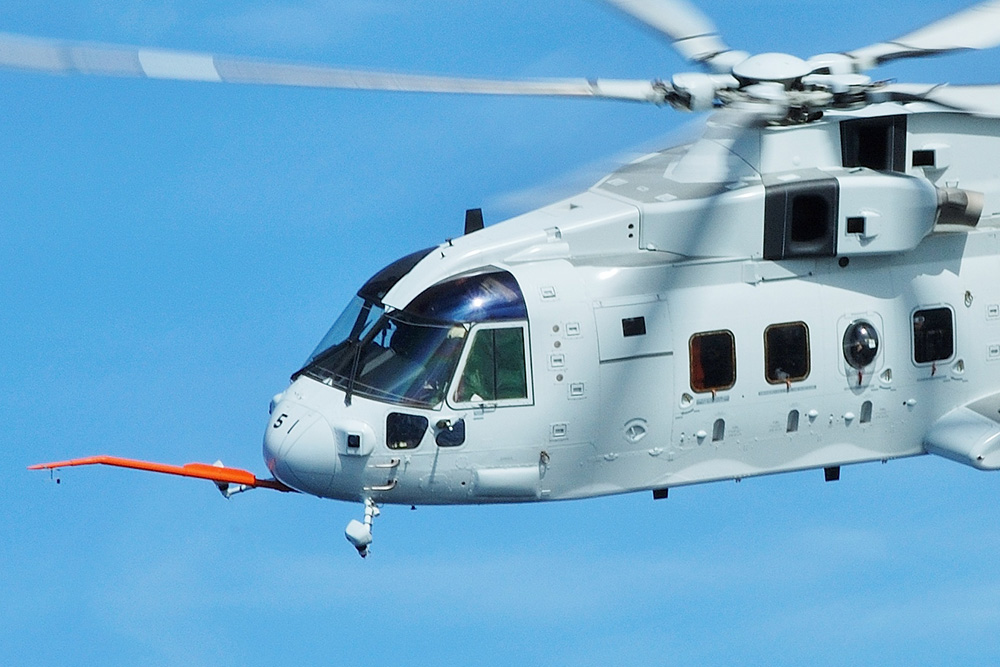
Here the refueling probe is attached to the nose of the MCH-101. Also, the rear-view mirrors are better visible. (photo: 海上自衛隊/Wikimedia, modified)
EH101 Mk519 (Lockheed-Martin VH-71A Kestrel)
The details around the external appearance remain scarce, but the test helicopters (designated EH101 Mk519) for proposed replacement for the US presidential helicopter fleet seem to have three large square and two narrow cabin windows on the right side, and a small window in the emergency exit. On the left are four square windows with a narrow one in the middle. It also has a folding tail and main rotor blades. It is not clear whether this was the definite configuration for the VH-71A.
AW101 Mk610
The version used by the Algerian navy is recognised by the small radar disk under the front fuselage (like on the Portuguese Mk514/5/6), no foldable tail boom and no RWR sensors on the nose. The AW101 Mk610 has five large cabin windows on the left side, four in a row and a single, followed by a bubble window. On the right are a single window, a window pair and a bubble window. It has two hoists on the right side.
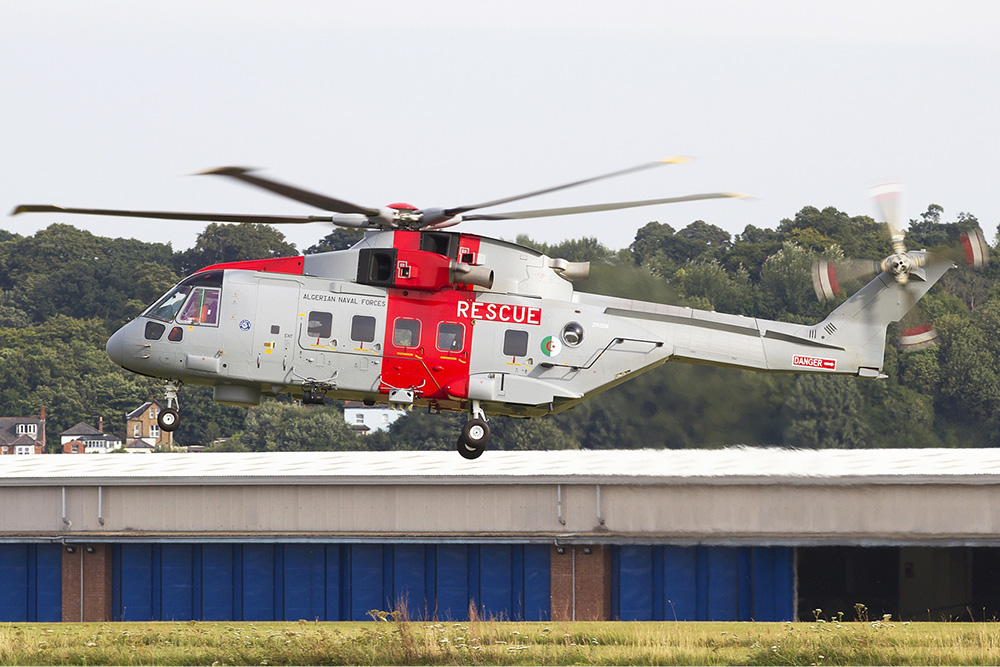
On the left side of the Algerian navy AW101 Mk610 are five square cabin windows and a bubble window. The nose is clean. (photo: Chris Lofting/Wikimedia)

The radar disk of the AW101 Mk610 is similar to that of the Portuguese AW101s. Note as well the two hoists and the three square cabin windows. (photo: Chris Lofting/Wikimedia)
AW101 Mk611 (HH-101A Caesar)
The nose of the HH-101A Caesar, the Italian combat search and rescue variant, is quite similar to that of the Danish Mk512. On the AW101 Mk611 there is a spherical sensor dome below. There can be a refueling probe under the right side of the nose, slightly angling up in front of the nose. There are five cabin windows on the left, in the 1+3+1 configuration, followed by a bubble window. On the right side are four large windows followed by a bubble window. There is no folding tail boom. Finally, there are many sensors at the back of the sponsons.
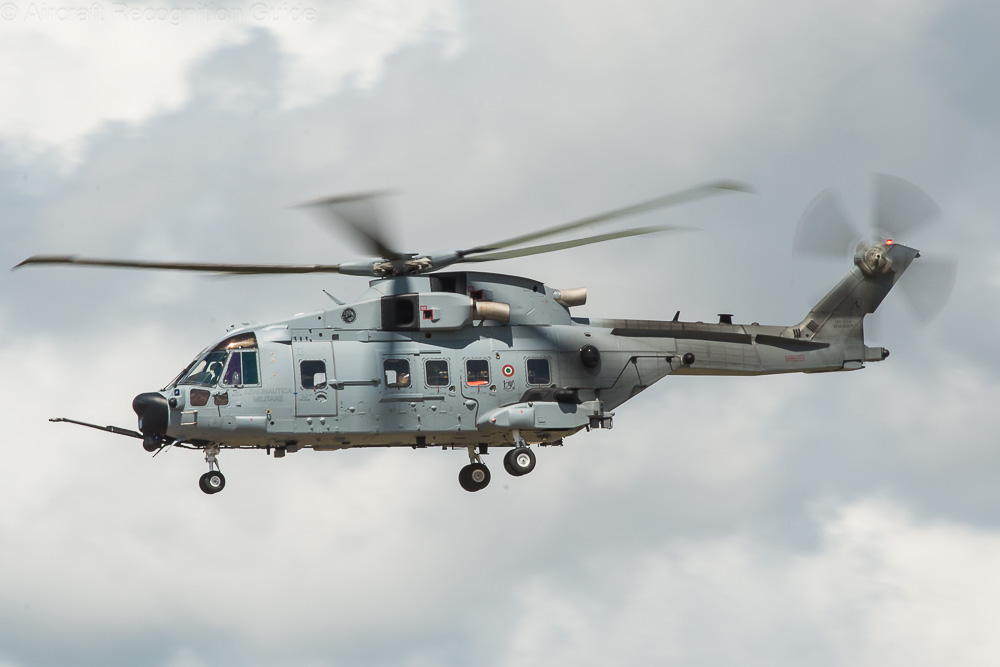
The 1+3+1 cabin window configuration on the left side of the AW101 Mk611, aka HH-101A, is apparent, as is the optional refueling probe.
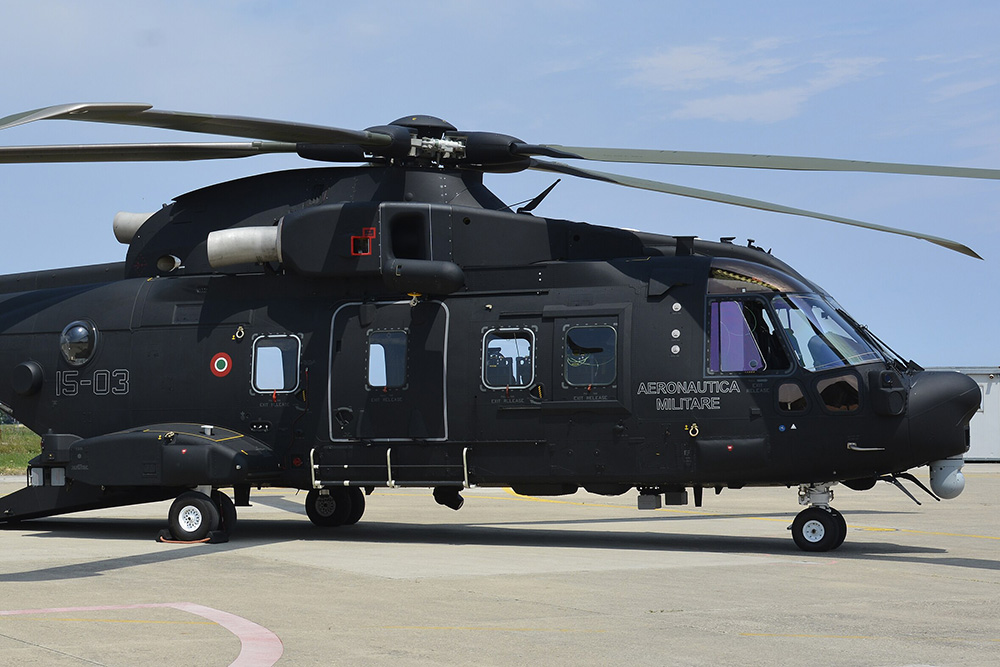
The nose and cabin window configuration of the HH-101A Caesar are better visible on this detail photo. (photo: Alfonso Mino/Wikimedia, modified)
AW101 Mk612
Another version with a unique cabin window configuration is the AW101 Mk612 of the Norwegian air force. On the left are two bubble and two normal windows in a row, alternating and starting with a bubble window. A bit further aft is a third square window. On the right there is a bubble window in the door, flanked by two square windows. The nose is like that of the AW101 Mk611, including the sensor dome. There are two hoists on the right, and the tail is not folding.
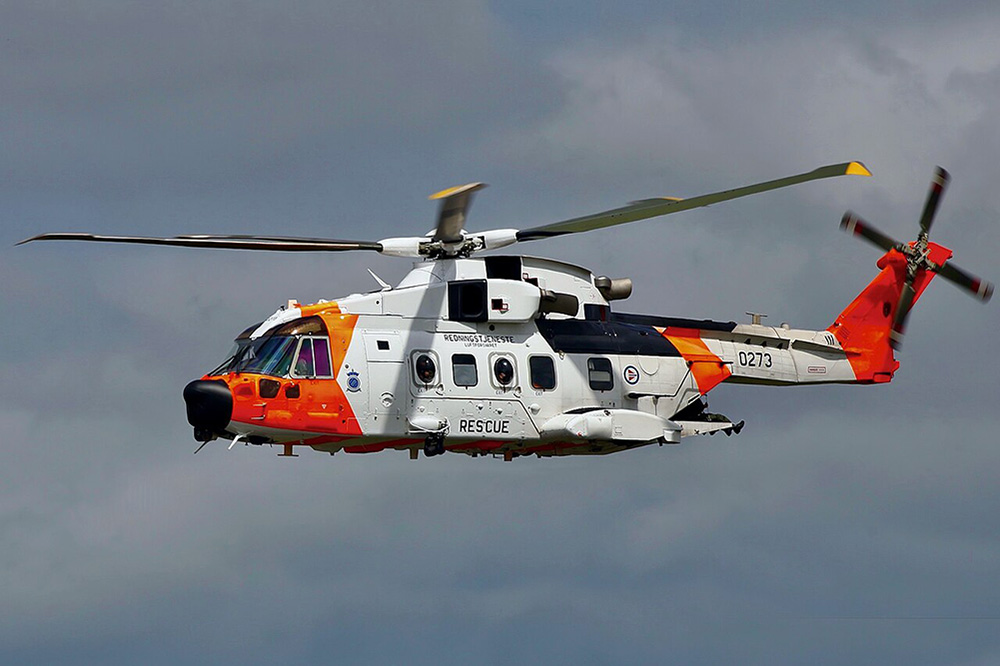
The Norwegian air force AW101 Mk612 has alternating bubble and flat square cabin windows, and a radar nose. (photo: Colin Cooke/Wikimedia)

Like for so many EH101/AW101 versions, a photo of the other side of the AW101 Mk612 is needed to show the unique cabin window pattern, as well as the two hoists. (photo: Ronnie Robertson/Wikimedia, modified)
AW101 Mk614
Key features of the Polish navy AW101 are a small radar disk under the forward fuselage, a sensor dome under the nose, radar warning receivers at the sides of the nose and at the end of the tail boom, a single winch and of course the cabin windows. The Mk614 has two square windows on the left, nearly front and rear end of the cabin, and three on the left, one in the cabin door and one on each side of the door. Like the other Mk600 series, it has no foldable tail boom.
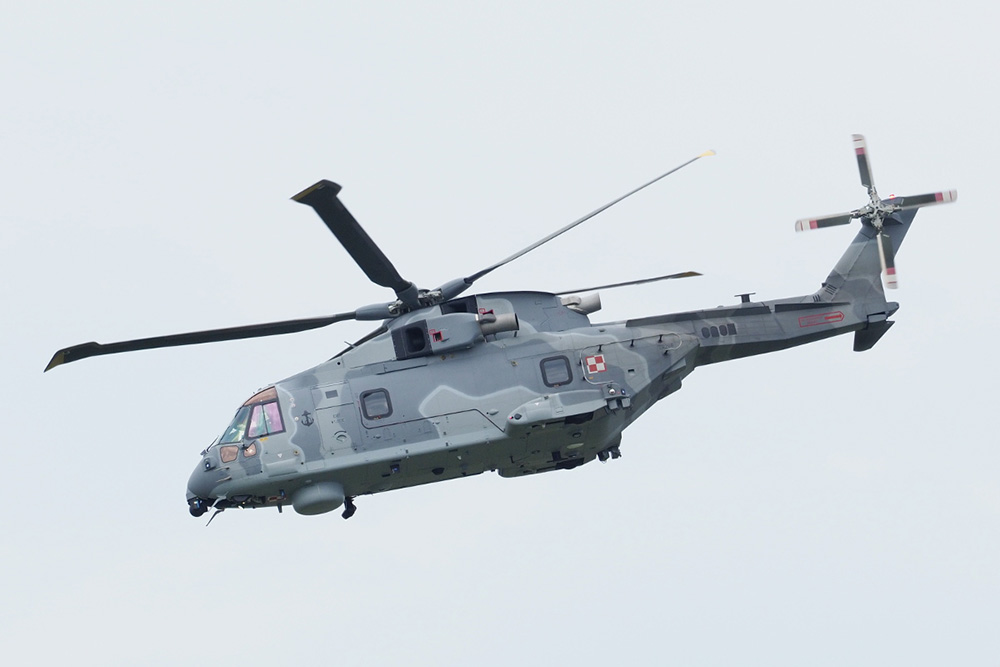
There must be limited daylight inside the cabin of the Polish navy AW101 Mk614, because on the left side there are only cabin windows near the front and rear of the cabin. (photo: Boevaya mashina/Wikimedia)

On the right side there are three large cabin windows in the middle though. Other features are a small radar disk and a nose-mounted sensor turret. (photo: Jakub Hałun/Wikimedia)
AW101 Mk640
The Saudi VVIP AW101 are equipped with radar warning receivers at the sides of the nose and at the end of the tail boom, and a sensor dome underneath the nose. On the left side are two square cabin windows, then a narrow window and a single square window. the configuration on the right side is not known to us. At the ends of the sponsons are missile approach warning systems.
AW101 Mk641 & AW101 Mk642
The AW101 Mk641 VVIP helicopter was ordered by India, but in the end not delivered. They look like the Saudi Mk640, but have a clean nose except for the RWRs. There are five cabin windows on the left, of which the middle one is a narrow one. On the right there are also five windows, on which the first is narrow and the fourth in the emergency exit smaller than the others.
The Algerian AW101 Mk642 is externally the same as the Mk641, except that there are flare dispensers(?) on top of the sponsons, and radar warning receivers(?) at the end of the sponsons.
AW101 Mk643
Turkmenistan’s VIP AW101s have a clean nose, no sensors and no radar warning receivers. The cabin windows are different for specific examples. One has three square windows in a row on both sides, accompanied by a narrow one next to the cockpit on the right side. Another has a pair of square windows and a single separated one on the left, and a narrow, two square and a small window on the right.


.jpg)
.jpg)


.jpg)
.jpg)

,_Radom_Air_Show,_20230826_1514_9519.jpg)
The AW101 Mk643s are the 'cleanest' VIP AW101s, with hardly any pimples or bulges. EZ-S715 is the one that has a narrow cabin window, two square windows and a small window on the right side. (photo: Marek Vanzura/Wikimedia)

Similar helicopters
Some helicopters look so similar to the AW101/EH101 that you may confuse them. Below you can read how to distinguish them.
Differences EH101/AW101 & S-92

The biggest competitor to the EH101/AW101 is also the most similar looking helicopter. The S-92 has two engines though, at the sides of the gear box fairing, much larger sponsons, a four blade main rotor and a tail rotor on the right side, to name a few eye-catching differences.
Differences EH101/AW101 & NH90

While the NH90 is significantly smaller than the EH101/AW101, and has a distinctive 'bone line' and has two engines, they are still similar in appearance thanks to the rear loading ramp, square cabin windows and tail area. Other differences are that the EH101/AW101 has - in most cases - a twin wheel main gear, and a five-blade main rotor.
Differences EH101/AW101 & S-65/H-53

The older and bigger stablemate of the S-92 is also known for large sponsons, but is essentially different in other areas. The S-65 and H-53 variants have six or seven main rotor blades, two or three engines and a high mounted horizontal stabiliser on the right.
Differences EH101/AW101 & S-61R/HH-3

This derivative of the S-61/Sea King has more in common with the EH101/AW101 than the original. It has a loading ramp at the rear of the fuselage, large sponsons and an all two wheel gear. The S-61R and CH-3/HH-3 variants have a five blade main rotor but without the wide, curved tips, and a tail rotor on the left. It also has a high mounted horizontal stabiliser on the right and two engines on top of the fuselage.
Differences EH101/AW101 & Mil Mi-38
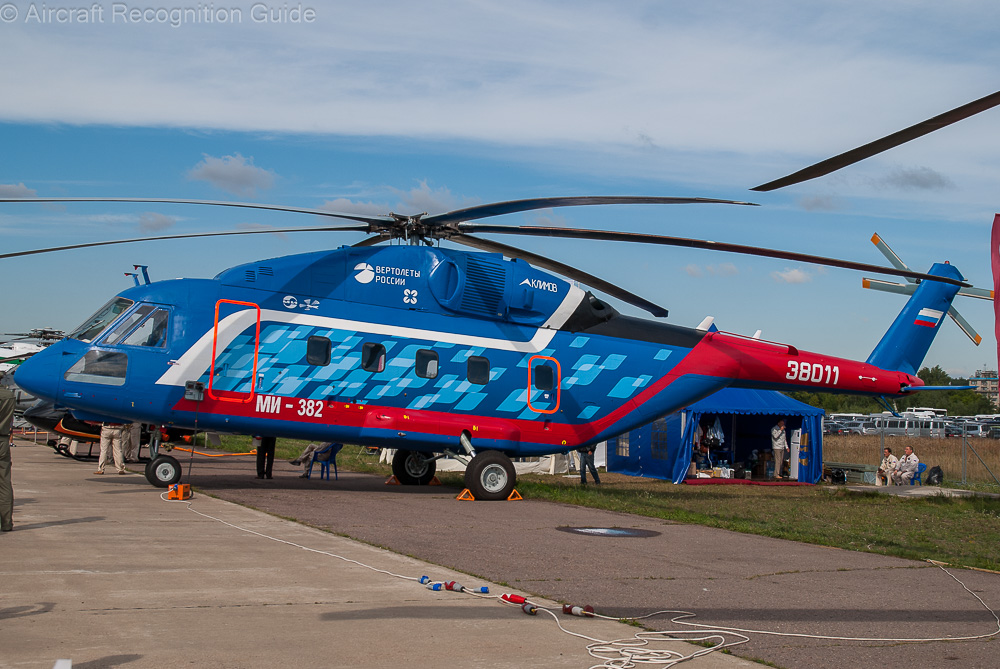
Russia's entry in this class of helicopters is the Mil Mi-38. You will immediately notice that unlike the AW101 this helicopter has no sponsons, a single wheel main landing gear and a six blade main rotor. Also, the angle between the four tail rotor blades is not equal.