
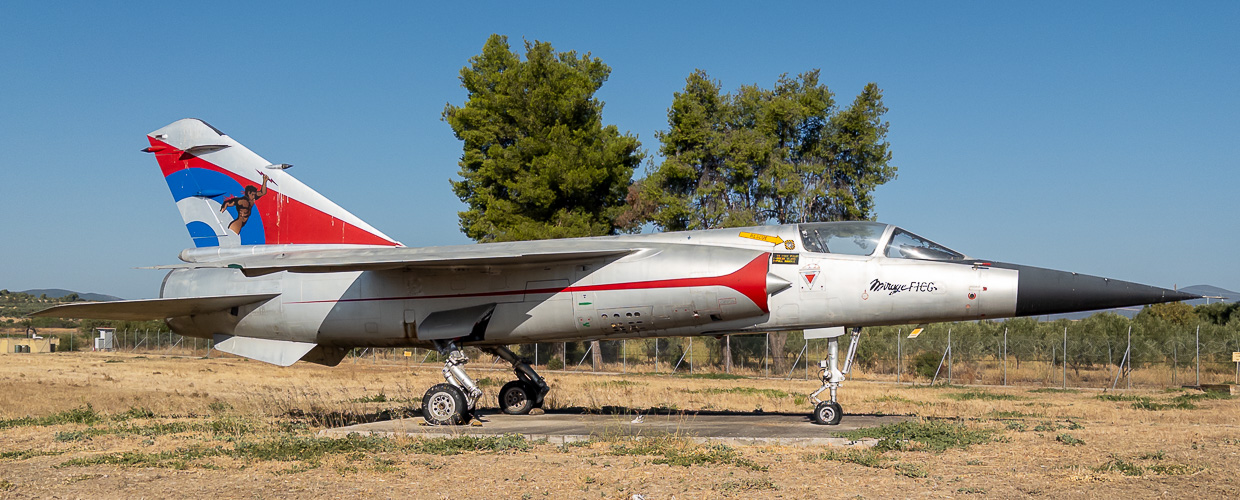
Dassault Mirage IIIF, Mirage IIIG & Mirage F1
While the Dassault Mirage is mostly known for being a delta wing fighter, there were some distinctively different versions, all with high mounted, non-delta wings. The Mirage IIIF and IIIG series can be considered as prototype and development aircraft, and the Mirage F1 became a successful Mirage fighter branch, next to the Mirage III/5/50, Mirage IV and Mirage 2000. All the high wing Mirages share many characteristics of the Mirage III family, in particular the fuselage, cropped triangular vertical stabiliser and typical semi-circular air intakes with conical centre bodies. New are the horizontal stabilisers (not present on the delta wing fighters) and two-wheel, claw-like main landing gears, retracting forward in the lower fuselage.
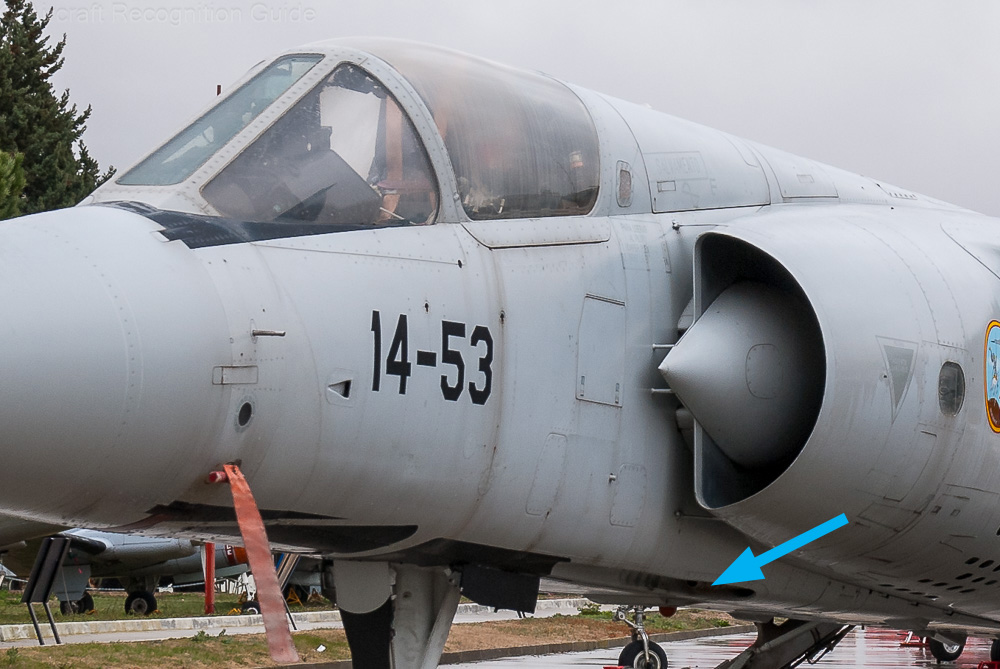
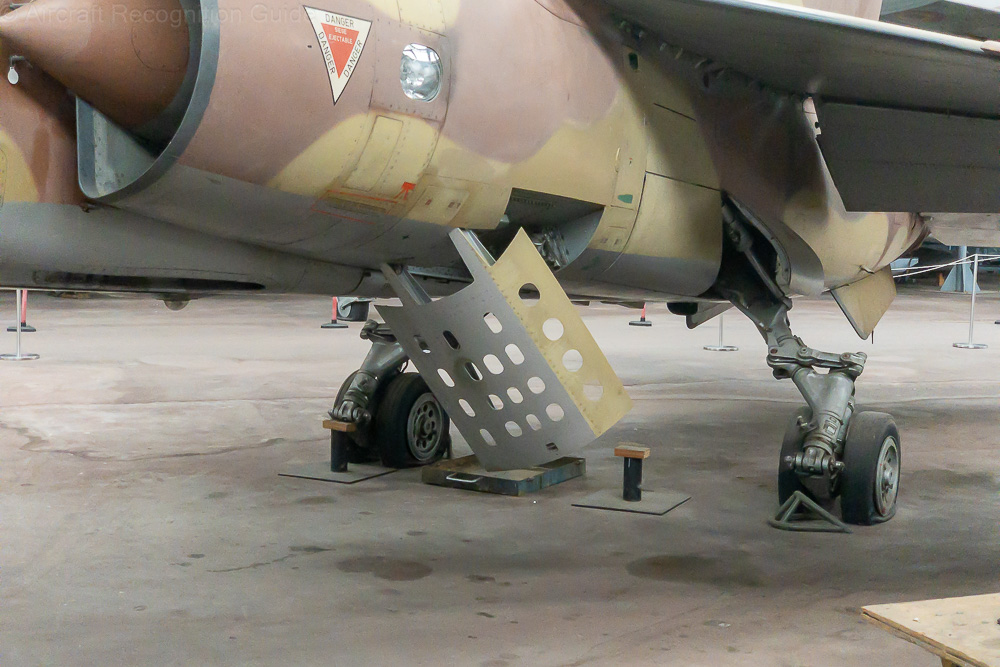
How to recognise the different versions of the Mirage IIIF/G & Mirage F1
The different versions of the Mirage IIIF/IIIG and Mirage F1 can be distinguished by looking at
- the number of seats and shape of the canopy/canopies
- whether it has fixed wings or variable sweep wings
- the number of wheels on the nose gear
- the shape and length of the nose
- the presence of ventral fins
- the shape of the vertical fin
- the presence of wing leading edge slats
- the presence of a fixed or retractable refuelling boom
- the number of guns
Mirage IIIF (Mirage F)
The eventual Mirage F1 evolved from three Mirage F (Mirage IIIF) development aircraft, of which the Mirage IIIF2 (Mirage F2) was the first. It is the largest of the Mirage F prototypes, with two seats under separate canopies. Furthermore, the Mirage IIIF2 has cropped delta wings, a single wheel nose gear, double wheel main gears, no ventral fins, a straight top of the vertical stabiliser and a large diameter nose.
The Mirage IIIF1 was the second and the smallest of the three. The single seater has a short, Mirage III-style nose. For the rest, it is similar to the Mirage IIIF2.
As an interim step in scaling down the Mirage IIIF, the Mirage IIIF3 was only partly built before the programme was focussed on the F1. It never flew.
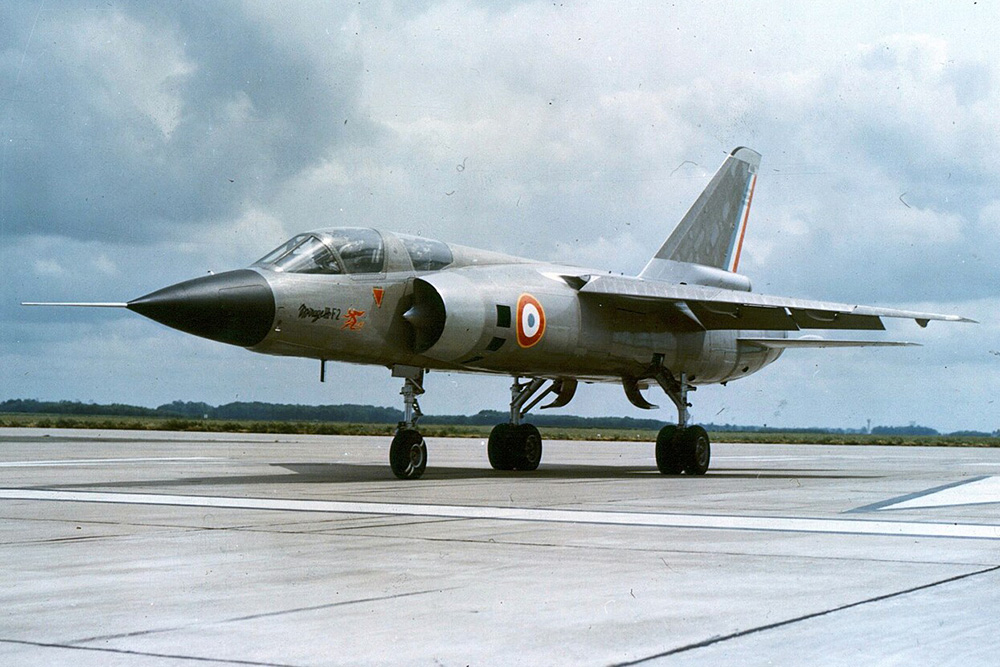
The development of what became the Mirage F1 started with the Mirage F2, which is longer than the Mirage F1, has two separate canopies and a single wheel nose gear. (photo: Aerolegende/WikiMedia)
Mirage IIIG (Mirage G)
The Mirage IIIF formed the basis for the variable sweep wing programme of Dassault, called Mirage G. The first one, just called Mirage G, is essentially a Mirage IIIF2 with the new variable sweep wings with full-span double-slotted trailing edge flaps and two-position leading edge flaps.
Of the bigger Mirage Gs only the Mirage G8 was built. These are twin engined airplanes with a slimmer nose cone. Both the G8-01 and G8-02 had a tandem canopy, but the rear one of the G8-02 was faired over because its space was used for equipment.
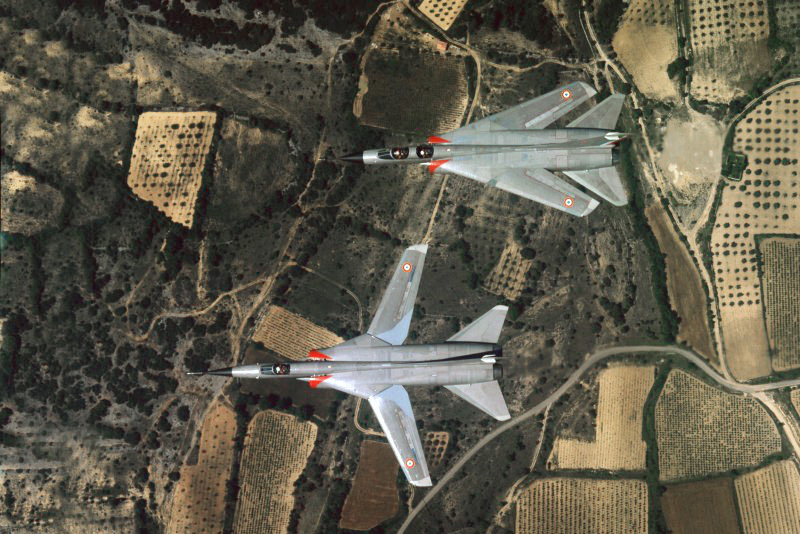
From above the variable sweep wings are apparent on these Mirage G8s. As you can see they have two engines. The one with the smallest sweep angle is the single seat Mirage G8-02. The other is the dual seat Mirage G8-01. (photo: Dassault Aviation/WikiMedia)
Mirage F1 prototypes
With the Mirage IIIF1 series being selected as the basis for the new fighter, further prototypes of the Mirage F1 were built. The second prototype is only different in that it has a longer nose, based on that of the Mirage 50. Later during the development, and two ventral fins were added. The top of the tail fin became pointed and horizontal blade antennas were placed next to the top of it. Also, the third prototype received leading edge slats on the wings. Finally, a two wheel nose gear was adopted.

Mirage F1A
Only meant for the attack role (A=Appui, attack), the Mirage F1A series has a smaller radar in the nose cone. The room becoming available is used to store a retractable refuelling probe, on the right side. Under the nose, in a slightly bulged fairing, is a forward looking laser rangefinder. In front of this, the pitot tube is slung under the tip of the nose. Furthermore, the Mirage F1A has two cannons, placed in the lower sides of the fuselage, under the air intakes.
Mirage F1AZ is the South African version of the F1A, and Mirage F1AD that of Libya. The Libyan examples have a small dorsal fin with an HF antenna, like the Mirage F1EQ.

The Mirage F1A was one of the basic versions of the Mirage F1, meant for attack. Shown here is a full view of a South African Mirage F1AZ. It is best recognised by the nose, see the next photo. (photo: Aeroprints.com/Wikimedia)

Typical for the Mirage F1A are the retractable refuelling probe, pitot tube extending from under the nose and the laser finder under the nose, all visible here. (photo: Col André Kritzinger/Wikimedia, modified)
Mirage F1B & Mirage F1D
For training purposed, the two seat version of the Mirage F1C has a slightly longer nose, in which the student and instructor sit behind each other under a long single canopy, that opens in two pieces. The cannons have been removed. A dummy refuelling probe can be attached for training purposes.
The version for the Spanish air force is designated Mirage F1BE, and in Jordan and Kuwait and Libya they are known as Mirage F1BJ and Mirage F1BK respectively. A special version was the multirole Mirage F1BK-2, that could be fully armed. The Libyan Mirage F1BDs and Iraqi Mirage F1BQs have a small dorsal fin, like the F1EQs. Mirage F1BQs were upgraded to F1BQ-2 and F1BQ-3 with different avionics and weapon systems, without leading to external differences.
Mirage F1D is the dual seat version of the Mirage F1E. The dedicated version for Qatar was Mirage F1DDA and for South Africa F1DZ. In Ecuador, they are called Mirage F1JE though.

There are two nearly identical dual seat versions of the Mirage F1, the Mirage F1B as shown here, and the Mirage F1D. The longer canopy compared to the single seaters is obivous. (photo: Jerry Gunner/Wikimedia, modified)

Externally, the Mirage F1BD and this Mirage F1BQ can be distinguished from the other F1Bs by the small dorsal fin. (photo: Shahram Sharifi/Wikimedia)
Mirage F1C & Mirage F1E
This is the basic single seat fighter version (C stands for Chasse, fighter) , that has all the features of the later prototypes. It has the two cannons of the F1A, but no laser rangefinder and no refuelling probe. The pitot tube is located in the tip of the nose cone. The version for the Spanish air force is designated Mirage F1CE, for the Hellenic air force Mirage F1CG, Mirage F1CH for Morocco, Mirage F1CJ for Jordan, Mirage F1CK in Kuwait and for the South African Air Force Mirage F1CZ. The F1C version for the Libyan air force is confusingly designated Mirage F1ED, while the multirole Kuwaiti version is designated Mirage F1CK-2.
Mirage F1E is the designation used for the multirole variant, but externally it is not different from the dedicated air defence F1C version. The version for the Qatari air force is designated Mirage F1EDA, while that of Morocco and Jordan are Mirage F1EH and Mirage F1EJ respectively. The Libyan F1EDs and Iraqi F1EQs can be recognised by the small dorsal fin, in which an HF antenna is placed. In Ecuador this version is designated Mirage F1JA. Iraqi F1EQs received several avionics and systems updates during the production run, from the initial Mirage F1EQ-1, to the EQ-4, EQ-5 and EQ-6. From the F1EQ-4 on a fixed refuelling probe was added. The F1EQ-6 variant can be distinguish by the ‘cubic’ radar warning receivers in the leading and trailing edge of the vertical fin, in place of the pointed conical ones, like those on the Mirage F1CT.

Compared to the Mirage F1A, the attack version, the fighter variant Mirage F1C has the pitot tube at the tip of the nose, but no refuelling probe and no laser sensor under the nose. Here a Greek Mirage F1CG is shown.

The Mirage F1ED, pictured here, and Mirage F1EQ have a small triangular dorsal fin with an HF antenna. For the rest they are the same as the standard F1C/F1E. (photo: Rob Schleiffert/Wikimedia, modified)
Mirage F1C-200 & Mirage F1E-200
Compared to the standard F1C the Mirage F1C-200 has a fixed refuelling probe attached to the right side of the fuselage, just ahead of the cockpit. This version is 7-8 cm longer to accommodate this probe. The tube can be removed however! The same change applies to the Mirage F1E-200 compared to the F1E. Spain, Iraq and Morocco have used these, with the dedicated designation Mirage F1EE-200, F1EQ-4/5/6 and F1EH-200 respectively.

The Mirage F1C-200 has a fixed refuelling probe as standard, but it can be removed. Then the 8 cm extra fuselage length is not sufficient to distinguish it from a Mirage F1C.
Mirage F1CR
Under the fuselage, just the front of the nose gear, is a bulged fairing with windows, holding the cameras of this reconnaissance version of the Mirage F1C. The windows allow photos to be made to the left and right side of the airplane. Additionally, the left cannon on the Mirage F1CR has been replaced by an infrared scanning system.
During an upgrade, likely simultaneously with the conversion of the F1C-200 to the F1CT, the remaining Mirage F1CRs got the square RWRs in the tail, like those of the F1CT.

Apart from being able to carry camera pods at the centreline pylon the Mirage F1CR has a bulge under the nose for cameras looking down or to the side. (photo: TimFelce (Airwolfhoud)/Wikimedia)

From a distance the bulge of the Mirage F1CR may be confused with that of the Mirage F1CT. Look for the windows at the sides of the bulge to identify the airplane as a Mirage F1CR. (photo: Laurent Errera/Wikimedia, modified)
Mirage F1CT
A conversion of the Mirage F1C-200 to make it more suitable for ground attack turns it into the Mirage F1CT. Externally, it differs from the F1C-200 by the addition of a laser rangefinder under the nose (similar to the F1A). The pitot tube remains at the tip of the nose though. They also received ‘cubic’ radar warning receivers in the leading and trailing edge of the vertical fin, in place of the pointed conical ones.
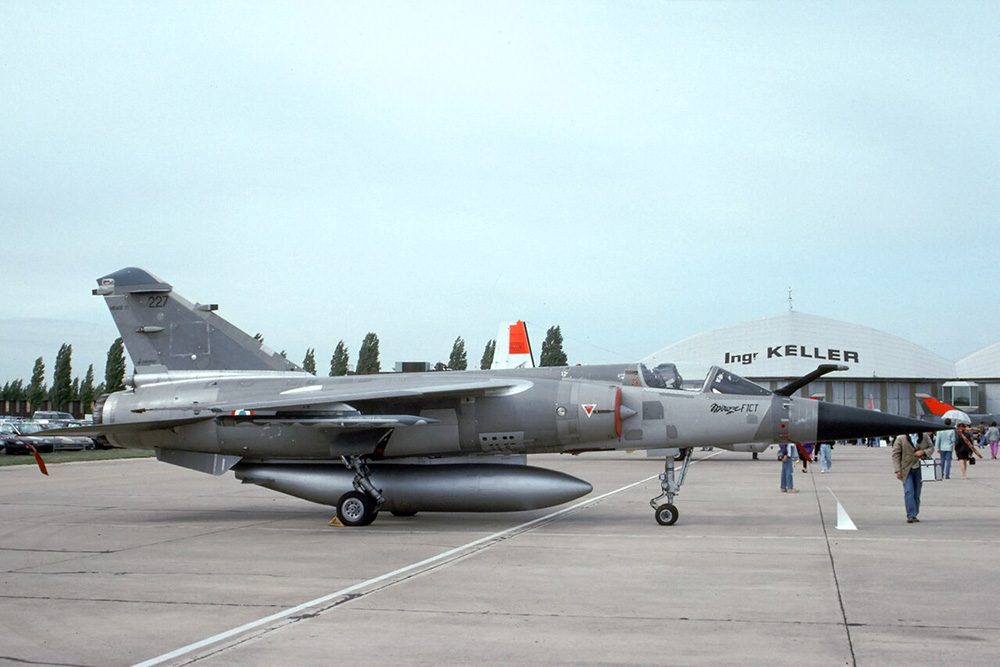
The Mirage F1CT differs from the Mirage F1A, that also has a laser pointer under the nose, by the pitot tube at the point of the nose and the fixed refuelling probe. (photo: Rob Schleiffert/Wikimedia)

The blue arrows mark the square or cubic radar warning receiver antennas that are typical for the Mirage F1CT and later also fitted to the Irqai Mirage F1EQ-6, Spanish Mirage F1M and French Mirage F1CR. (photo: GerardvdSchaaf/Wikimedia, modified)

Looking closely at the nose of the Mirage F1CT you can see that there is only a window at the front of the bulge under the nose. (photo: USAF/Wikimedia)
Mirage F1E (Mirage F1 M53)
The second use of the designation Mirage F1E was when Dassault proposed the Mirage F1 for a European fighter competition, with the E standing for Europe. This version was a few cm longer than the standard F1, had slightly larger air intakes and an exhaust nozzle with longer petal plates, associated with the SCENMA M53 engine. Hence, this version is also called Mirage F1 M53. The version has a clean nose, without refuelling probe and streamline bodies for sensors.
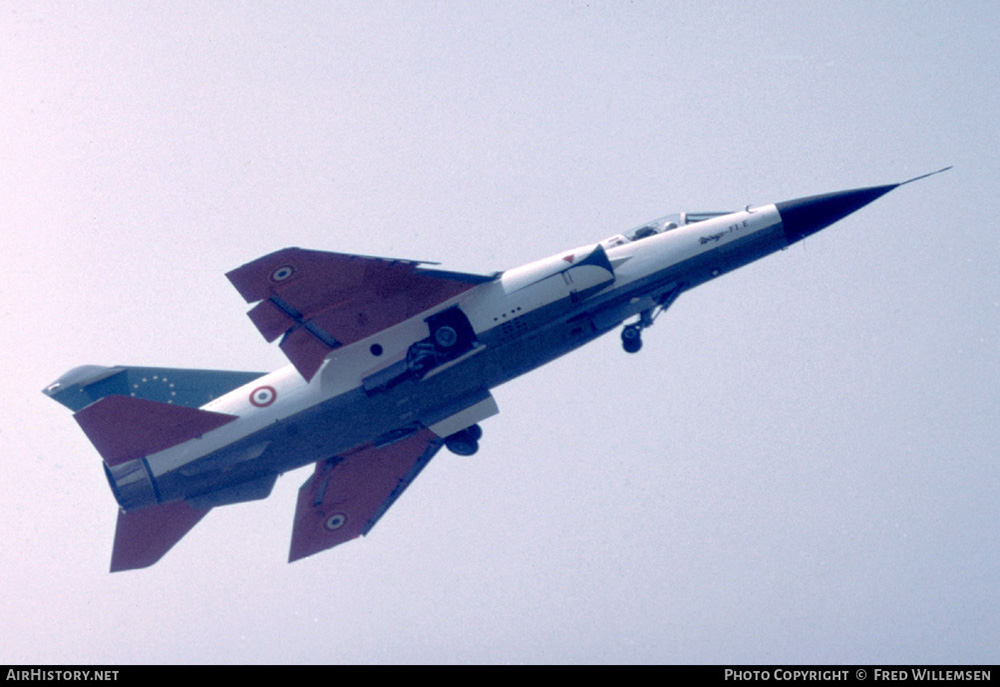
To recognise this Mirage F1 as the single Mirage F1E a.k.a. Mirage F1 M53, you'll have to look at the exhaust, as the M53 engine has longer petal plates than the original SNECMA engine. (photo: Fred Willemsen, used with permission)
Mirage F1M
Spain gave its Mirage F1Cs, F1Es and F1E-200s a mid-life upgrade, after which they were called Mirage F1M. Externally, the only difference is the ‘cubic’ radar warning receivers in the leading and trailing edge of the vertical fin, in place of the pointed conical ones.


.jpg)


.jpg)
_%22100_ans_de_reco%22_604_118-CF_-_ER_2_33_Savoie_(9690098670).jpg)
.jpg)
.jpg)
This Spanish Mirage F1 is an upgraded Mirage F1M, judging the square or cubic radar warning receivers in the tail, just like the Mirage F1CT has. (photo: Aldo Bidini/Wikimedia)
Similar aircraft
Some airplanes look so similar to the Mirage F1 that you may confuse them. Below you can read how to distinguish them.
Differences Mirage F1 & MiG-23/27
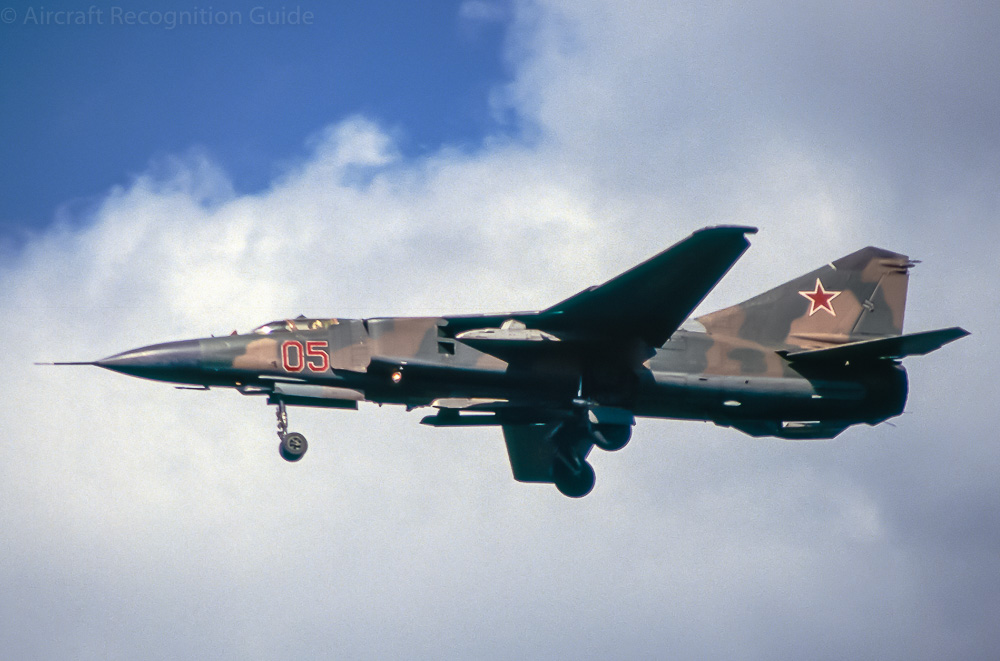
The tail and high mounted wings are the main commonalities between the MiG-23/27 and Mirage F1. These wings have a variable sweep angle. Additionally, the MiG has single wheel main landing gears and rectangular air intakes without a shock cone, but with a splitter plate.
Differences Mirage F1 & SEPECAT Jaguar
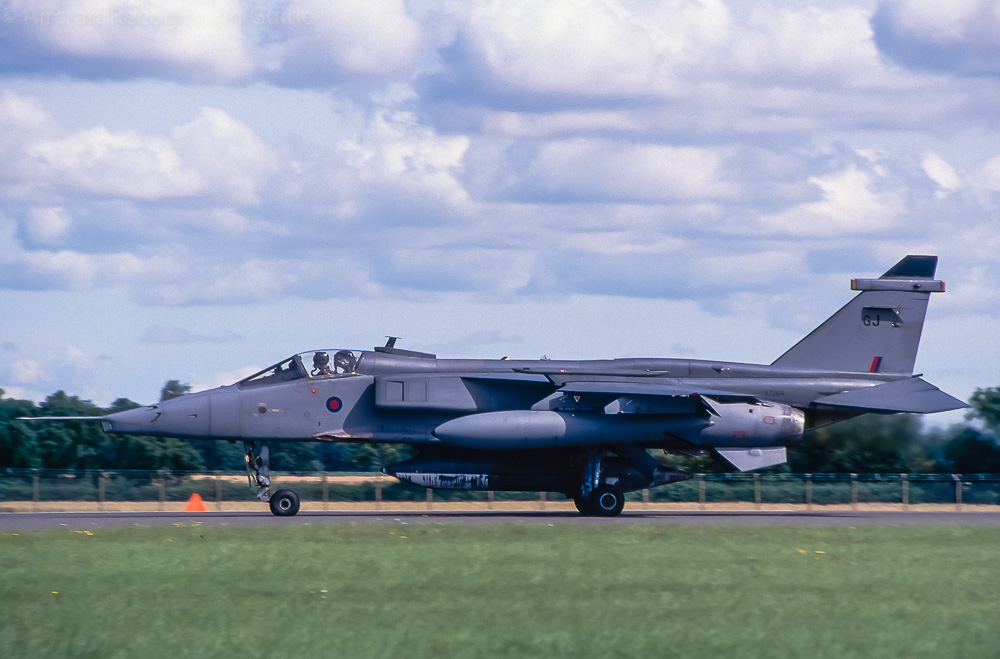
Regarding the shape of the wings and main landing gear, the Jaguar looks quite like a Mirage F1. The Jaguar has two engines though with small square air intakes behind the canopy, and exhausts below the tail. Also, the nose gear is of a trailing link type.
Differences Mirage F1 & Mitsubishi F‑1/T‑2
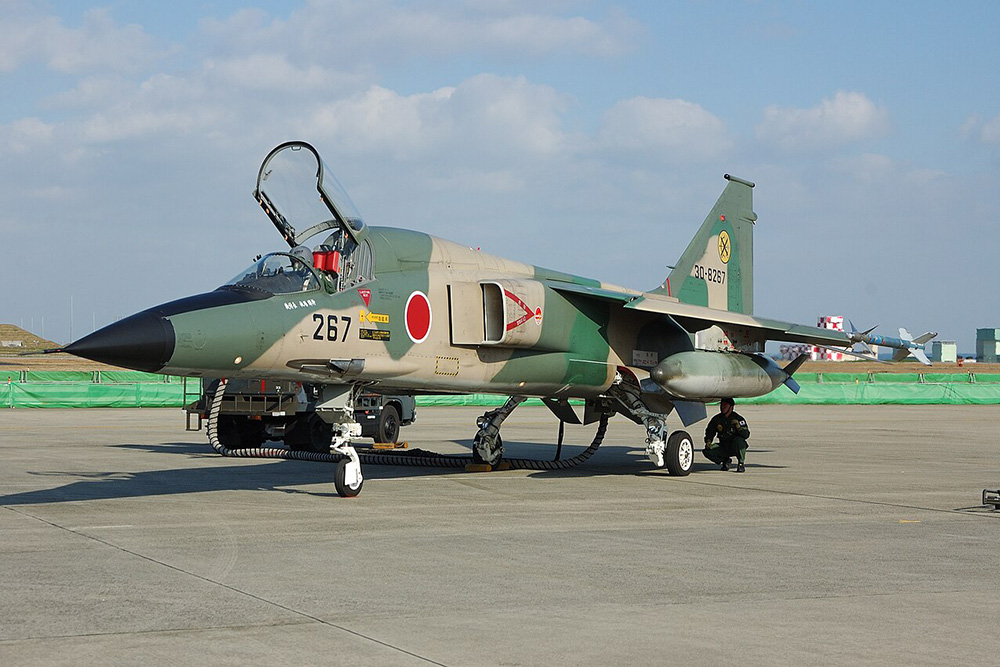
Another high wing fighter with swept wings is the Mitsubishi F-1 (and its dual seat sibling T‑2). Like the Jaguar the F-1/T-2 has two engines with small rectangular air intakes behind the canopy, and exhausts below the tail. Also, the gear has single wheels on all legs and the vertical stabiliser has a trapezium shape. (photo: PhantomII.Rider/Wikimedia)

Differences Mirage F1 & Soko J-22 Orao

The Orao is a twin engined fighter of similar appearance to the Jaguar, so the differences compared to the Mirage F1 are also similar: in particular the double wheel, claw-like main landing gear and wings. The Orao has nearly small D-shaped air intakes and exhausts at the very rear of the fuselage. Also, it has a single wheel nose gear.
Differences Mirage F1 & Mirage III/V/50
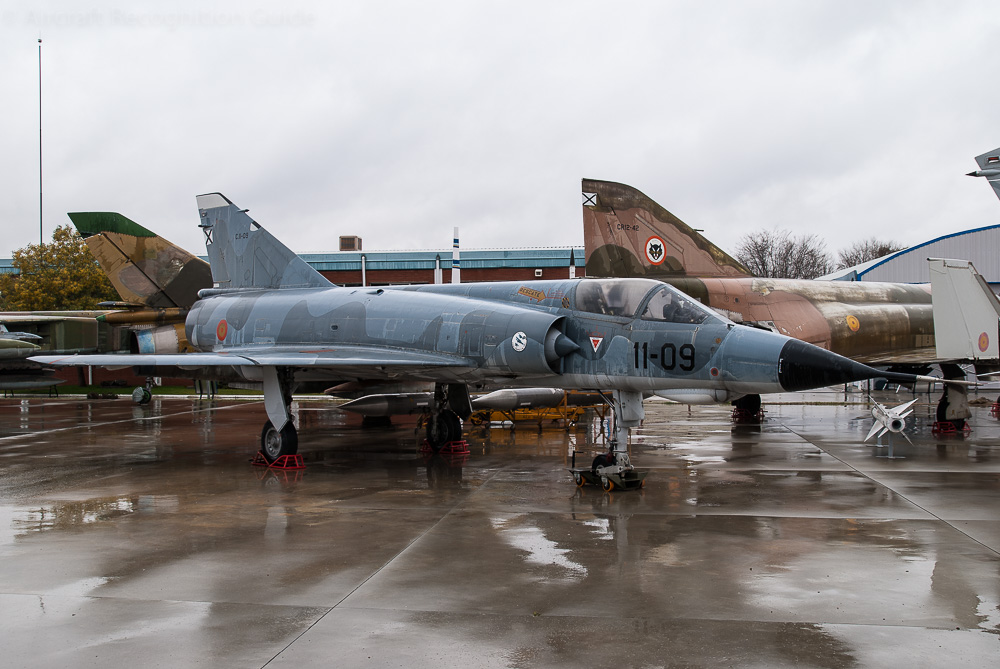
If you look at the fuselage, canopy, air intakes and tail the first generation Mirage is obviously a source for confusion. However, the old Mirage III, V & 50 of course have delta wings (mounted low), no horizontal stabilisers and single wheel main landing gears retracting inward in the wings.