

Agusta A129 Mangusta & TAI T129
Already in the 1970s the Italian company Agusta started the development of a dedicated attack helicopter. This became the A129 Mangusta, that shares some components with the A109, although that is not really visible in the end result. Like many similar helicopters, the A129 has a narrow fuselage in which the pilot and gunner/weapons operator sit behind each other. They have separated, stepped canopies that open on the sides. Also typical are the short (stub) wings, which have two pylons each. The fixed gear has two single wheel main gears attached to side and bottom of the front fuselage, and a single wheel tail gear under the ventral fin. The Mangusta's tail is quite swept swept, and has a two blade tail rotor on the top left. Horizontal stabilisers are attached at the base of the vertical fin. The main rotor has four or five blades. Main and tail rotor are powered by two turboshaft engines placed against the upper sides of the fuselage.
The TAI T129 ATAK is a further evolution of the A129, jointly developed by AgustaWestland and Turkish Aerospace Industries (TAI). Being externally very similar, it is included on this page.

The A129 has separate, stepped canopies, of which the side panels can be opened. Note the typical external box for the ammunition belt feeding the chin mounted gun on all models except the A129 & A129A.
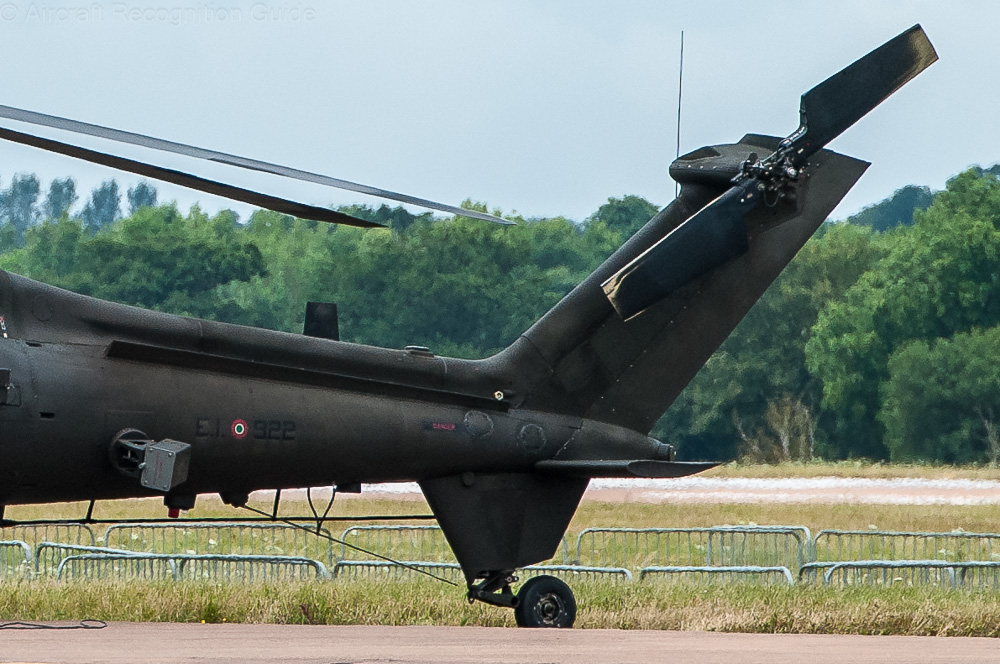
The A129 Mangusta has a two blade tail rotor, not often seen in modern helicopters. Typical is the ventral fin with the tail wheel.
How to recognise the different versions of the A129 & T129
To distinguish the different versions of the A129/T129 you will have to look at
- the number of main rotor blades
- the presence of a gun turret under the nose, and associated external ammunition belt on the left
- the shape of the sensors on the nose
- the shape of the engine nacelles
A129
Five prototypes of the A129 Mangusta were built. They have a four blade main rotor. Additional characteristics are the small sensors on the nose, and the lack of a cannon under the chin. The latter is also a feature of the A129A production version of the Italian army.

The lack of a cannon under the nose, only a few sensors on the nose and a four blade main rotor are the key features of the basic A129. (photo: Mike Freer-Touchdown aviation/Wikimedia)
A129A
Only the Italian army order the original Mangusta version, designated A129A. It is externally the same as the basic A129, but the sensors on the nose are much larger. First there is an optical sensor in a barrel shaped housing with flat top and bottom, on top of the nose and that can turn around the vertical axis. Below is a smaller sensor on its side, lined up with the helicopters roll axis, that can also turn around the vertical axis. Like the prototypes, the A129A has a four blade main rotor and no gun turret.
From 2012 on this version was called AH‑129A by the Italian army.
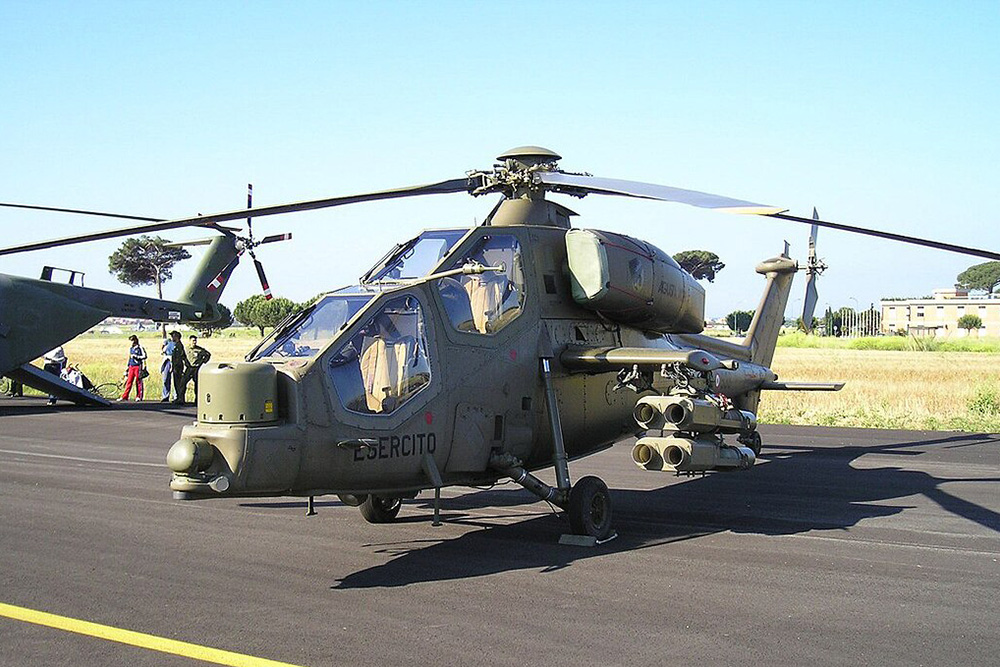
The lack of a gun turret is obvious on this photo of an A129A. Furthermore the large barrel shaped sensors on the nose are visible. They are in the closed position. (photo: Serendipity/WikiMedia)
A129 International
Agusta tried really hard to attract other customers for the A129, but had stiff competition from the AH-64 Apache. To make the Mangusta more suitable for export, the A129 International was developed. This has a five blade main rotor and a cannon under the nose. The sensors are similar to those of the A129A. Different though are the engines. These LHTEC T800 engines have a rectangular air intake in the curved front. This makes the nacelles the best recognition point.

A129C
Learning from the experience with the A129 International the A129A was upgraded to the A129C, called AH-129C in Italy. It has the same five blade main rotor and also a gun turret under the nose. The engines remained the same though, so the nacelles are also the same as on the A129A (and A129D).
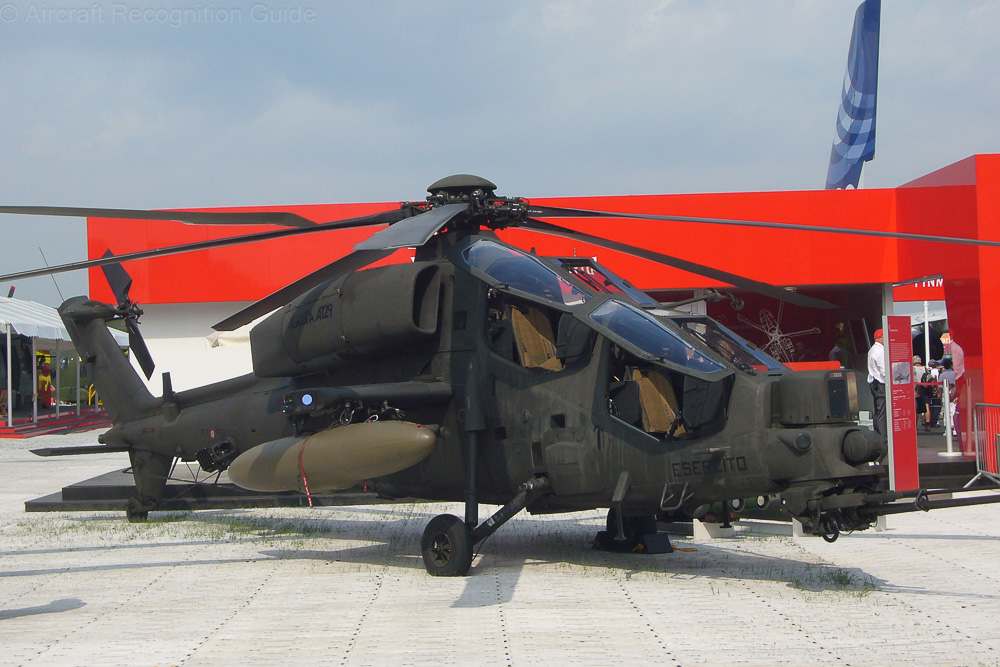
On this A129C both sensor housings on the nose are turned to show the sensors inside. The five main rotor blades and gun turret are also well visible.
A129D (AW129D)
The updated version of the A129C mainly has a different sensor on the nose. There is now a sphere-shaped one on top of the nose, much like on the T129. The smaller barrel-shaped sensor below of the previous versions remains.
The Italian military call this version AH-129D. And because Agusta had merged with Westland at the time of introduction, the manufacturer designation is also given as AW129D.
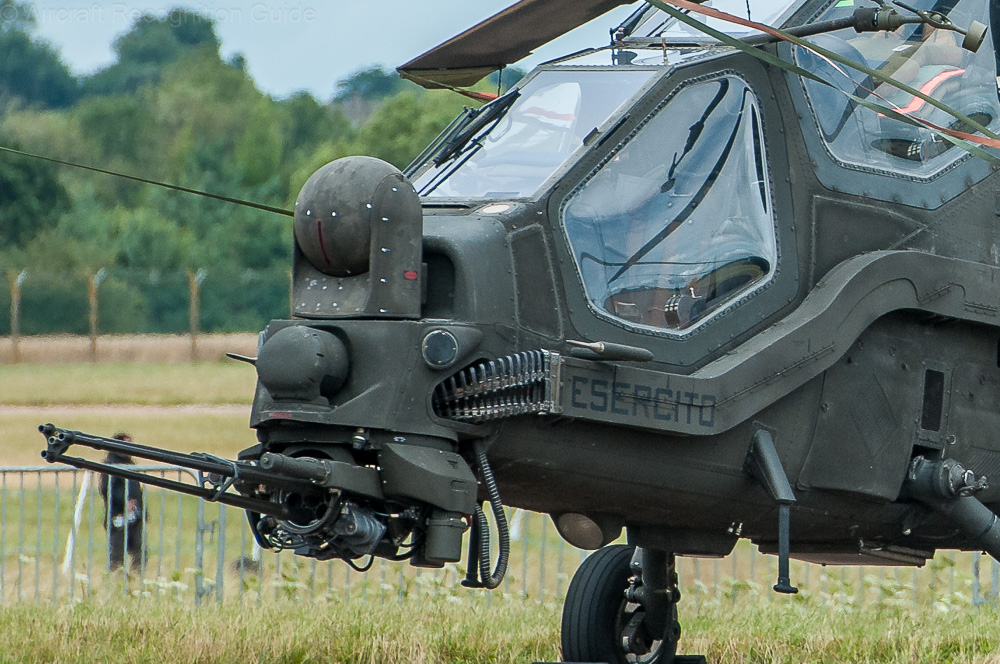
TAI T129A ATAK
Germany went a different way with the Tiger than the other customers. Its role as Unterstützungshubschrauber Tiger (UHT) required no gun turret under the nose. Even in its current role as Kampfhubschrauber Tiger (KHT) it can only use gun pods attached to one of the pylons. Another major difference compared to the HAD/HAP variants is the rotor mast mounted sight, a sphere containing infrared and TV cameras.


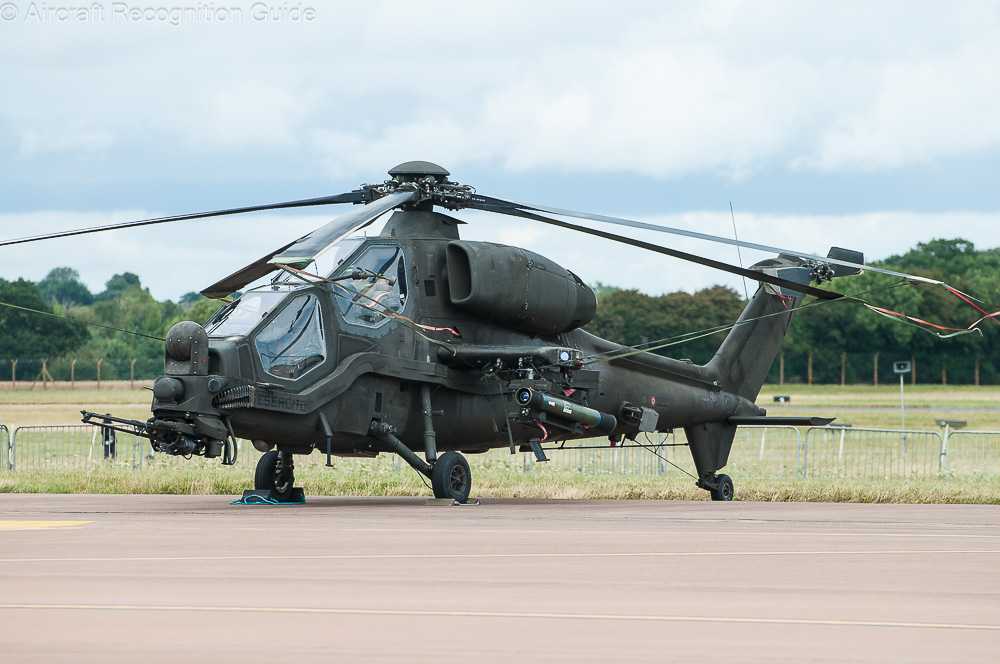
The engine nacelles, with their canted air intakes, are the best way to distinguish the T129 from the A129.
TAI T129B ATAK
The improved T129B can carry and use a larger variety of weapons than the T129A. Apart from that, the main difference is in the shape of the tip of the stub wings. These tips are longer, visible in the larger distance between the radar warning receiver sensors at the front and back of the tip.


Externally, the main (only?) difference on this T129B compared to the T129A is the tip of the stub wings, marked with the blue arrow. (photo: Rhk111/Wikimedia, modified)

Similar helicopters
Some helicopters look so similar to the A129 & T129 that you may confuse them. Below you can read how to distinguish them.
Differences A129 & AW249 Fenice

This successor to the A129 has some elements of the former, but looks in many ways more like an apache. The AW249 reains the ventral fin which holds the tail gear. The tail rotor is on the right though and has four blades. Across is a single horizontal stabiliser. Furthermore, it has a continuous canopy and cheeks along the lower fuselage sides like the Apache. (photo: Italian Army/WikiMedia)

Differences A129 & Eurocopter Tiger

Superficially, the A129 and Tiger look similar, in particular the stepped, separate canopies and the ventral fin which holds the tail gear. The Tiger has a three blade tail rotor on the right though, a four blade main rotor and anhedral on the outer stub wings.
Differences A129 & Mil Mi-28
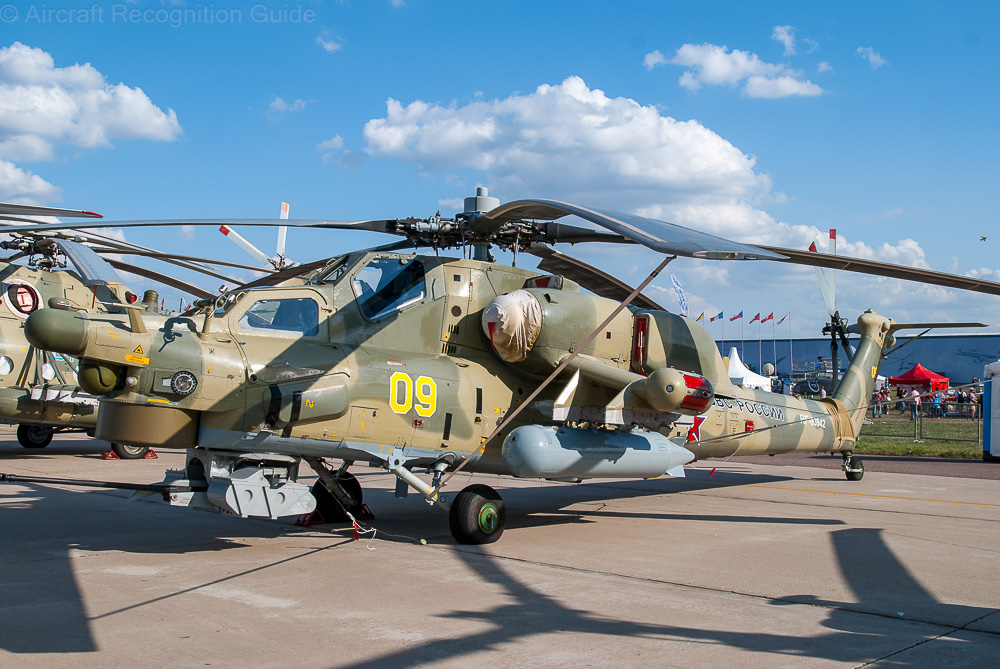
Like the A129, the Mi-28 it has separate, stepped canopies, a gun turret, a five blade main rotor and an all single wheel fixed gear, but there are many differences. The Mi-28 has a four blade, scissor type tail rotor, stub wings with anhedral along the full span and a single horizontal stabiliser without end plate attached to the top of the vertical stabiliser.
Differences A129 & Changhe Z-10

The Changhe Z-10 has separated, stepped canopies like the A129, a main rotor with five blades, a fixed tail wheel landing gear, a gun turret and low mounted horizontal stabilisers. Different is the scissor shaped four blade tail rotor and the distinctive body line along the fuselage and tail boom. (photo: 3GO*CHN-405/mjordan_6/WikiMedia)

Differences A129 & Denel Rooivalk
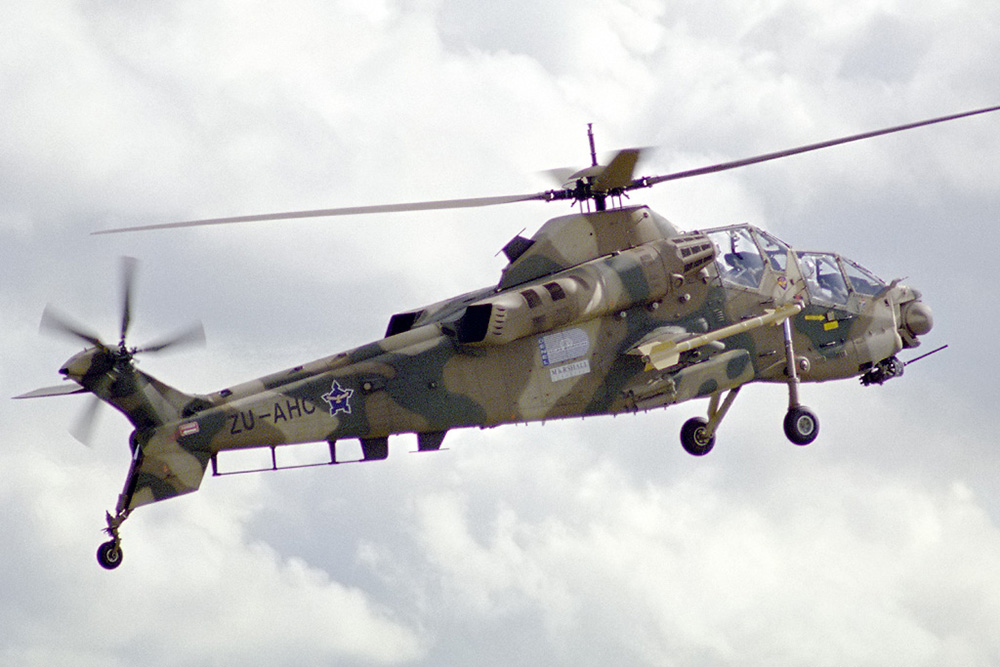
Another attack helicopter with a stepped cockpit with separate canopies and a thick ventral fin holding the tail gear is the Denel Rooivalk. This South African helicopter has a four blade main rotor though, and a five blade tail rotor on the right and a single horizontal stabiliser, on the left. (photo: Anthony Noble/WikiMedia)
